

Groove milling
While it may have different names, groove milling can be an effective way to perform slotting and slitting.
While it may have different names, groove milling can be an effective way to perform slotting and slitting.
As we all know, industry terms mean different things to different people. This is the case with “groove milling.”
“Words and terms are intermixed and overplayed no matter how you look at it,” said Duane Drape, national sales manager for HORN USA Inc., Franklin, Tenn. “The difference between groove milling and slot milling or slitting or anything along that line is hard to define.”
Courtesy of HORN USA
A HORN groove milling tool creates square, linear grooves. The same tool was used to bore mill the largest bore (including the face), groove mill the two grooves on that diameter and bore mill a smaller diameter from the bottom up.
William Durow, applications and development project coordinator for Sandvik Coromant Co., Fair Lawn, N.J., agreed that groove milling is basically slotting and slitting. “It depends on who you talk to, what industry they are in and, frankly, who they were taught by. But groove milling and slotting are fundamentally the same thing,” he said. Sandvik Coromant offers a full line of CoroMill indexable-insert groove mills.
Michael Trimble, product manager for Vargus USA, Janesville, Wis., said “groove milling tools to us are slotting tools that can run at higher speeds and feed rates than traditional slotting tools, such as Woodruff cutters.”
Turn Instead
A groove can be created via turning on a lathe or groove milling. “If you can produce the groove on a lathe, you do it,” said Matthew Schmitz, national product manager—GRIP products for Iscar Metals Inc., Arlington, Texas, which offers groove mills as part of its TANG, GRIP, CHAMSLIT and MULTI-MASTER products. “In nearly every case, it will take more time to generate that same groove on a mill than a lathe.”
Schmitz also noted that if the groove has a shape other than parallel sidewalls, the task becomes difficult on a mill and will likely require a special tool, which adds cost.
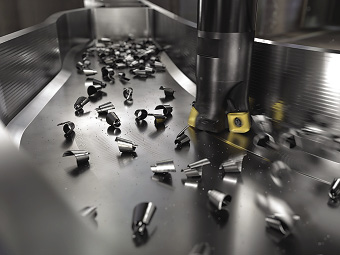
Courtesy of Sandvik Coromant
Sandvik Coromant’s CoroMill 329, typically used for deeper, narrower grooves, offers a DOC from 100mm to 160mm (4 ” to 5 “) and has a width from 2.5mm to 4mm (0.098 ” to 0.157 “).
“There are only a handful of reasons to use a mill for a groove rather than a lathe,” he said. “These include the shape or size of a workpiece, machine capability or capacity in a given shop, to gain chip control, to eliminate an additional setup and to control workpiece feature tolerances without the concern of an additional setup.”
Also, because groove turning uses a single-point tool, Schmitz feels it is more accurate.
Drape doesn’t necessarily agree that groove turning is more accurate—it is definitely application specific—but said with “groove milling you have a rotating tool so you will get more of a scalloped-type finish.”
Notable Inserts
Groove milling tools are available as solid carbide, with a replaceable head (or insert) that screws on the end of the shank or with indexable inserts that fit into pockets on the tool body.
“We offer solid and insertable based on a diametric requirement,” Drape said. When groove milling a small ID, an insertable tool might not fit. “We typically switch to insertable at 10mm in diameter and up,” he said.
As the diameter increases, the cost of solid-carbide tools gets progressively larger, which is where inserts come in. “The problem you can potentially run into with an insertable tool is there is a fine line where the accuracy of an insertable cannot be as good as a solid,” Draped added. “Because you have replaceable components, you can’t maintain the same accuracy.”
When the diameter is large enough, Vargus’ Trimble indicated that indexable-insert groove mills are more economical. Say a solid-carbide tool costs $150 vs. $150 for a tool body and $25 for a replaceable head (insert) with three or six teeth. If the solid-carbide tool produces 1,000 grooves and the insertable tool produces 1,000 grooves, the solid-carbide tool will cost more over the long run because the user has to pay for a completely new tool once it’s worn. (Vargus doesn’t recommend resharpening.) For the insertable tool, he only has to pay $25 for each replacement head. Vargus offers Groovex solid-carbide and indexable-insert groove milling tools.
Whether solid or insertable, groove mills create simple linear and circumferential grooves—a square bottom or half-round groove such as for internal circlip or O-ring grooves.
Insertable tools are more flexible in terms of grades and geometries because the head or inserts can be changed. These tools are used for angled grooving, chamfering, parting off and generating gear teeth profiles, Woodruff keyways and T-slots, just to name a few applications.
Add threading to the list. “Thread milling is nothing more than helical grooving,” Drape said. “A thread is a groove that commonly has 60°, 55° or 30° included sidewalls. It is a constant groove that is moving up a component. You have to use different-shaped tools but the process is the same.”
Making a Slit
Slitting cutters are applied to create narrow, square grooves up to a couple inches deep. “It is all relevant to the size of the groove, but it is usually deeper than the width of what you are grooving,” Drape said.
Iscar differentiates slitting and slotting cutters by noting slitting cutters are blade-type cutters that accept inserts that resemble parting or grooving inserts most commonly applied when turning. Slotting cutters are also blade-type cutters, but they hold inserts that resemble those typically found in milling cutters.
According to Iscar, slitting cutters are generally used when the width of the groove is less than ¼ “, while slotting cutters are for making wider grooves. However, there can be some overlap.
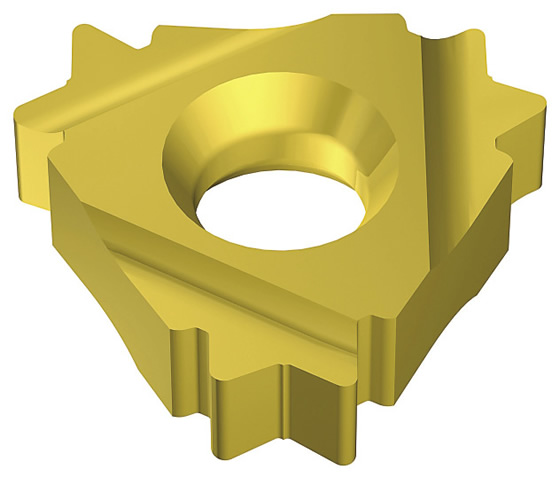
Courtesy of Vargus USA
Vargus USA’s Groovex GM Slot groove milling tools are available for creating groove widths from 1.2mm to 4mm and up to 3.25mm deep.
“Because the slitting cutter is such as expensive tool—you have to mount many expensive inserts—you use it only when you absolutely need to,” Schmitz said. “But for a long, deep groove that runs the length of a shaft, it might be more economical to use a slitting cutter [rather than a slotting cutter].”
Review the print ads from this magazine to continue
This quick advertiser review unlocks the rest of the article and keeps the full-screen reader focused on the ads instead of the page chrome.
Continue reading
August 2012
Related

 MFGAxis Discussion
Be part of the shop-floor conversation
Like, save, or comment on this CTE story.
MFGAxis Discussion
Be part of the shop-floor conversation
Like, save, or comment on this CTE story.


MFGAxis Discussion