

Groove Hard: Turning Performance
Grooving hardened steel parts with PCBN cutting tools.
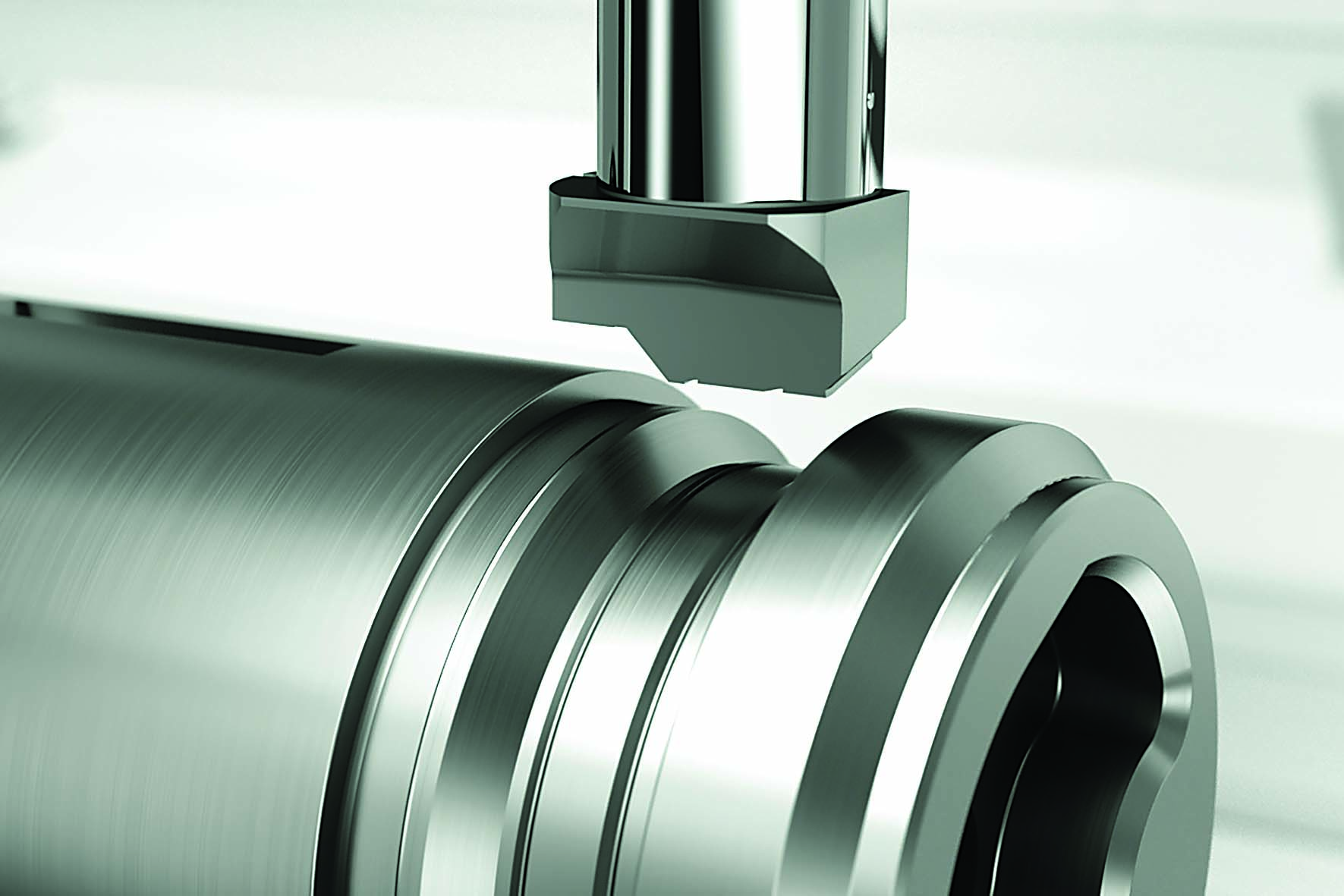
Courtesy of Sumitomo Electric Carbide
Grooving hardened steel parts with PCBN cutting tools.
Over the past decade, finish grooving hardened steel parts using polycrystalline cubic boron nitride inserts has increasingly replaced grinding. “Typically, grinding is a more stable process that provides more accurate tolerances than grooving,” said Tyler Economan, proposal engineering manager for INDEX Corp., Noblesville, Ind. “However, people are trying to do more complete machining on workpieces if the turning machine is capable of completing the necessary processes.”
Various work materials that are through-hardened include HSS, die steels, bearing steels and alloy steels. Only ferrous metals are casehardened and that process is typically reserved for low-carbon steel. Casehardening produces a hard, wear-resistant exterior over a tough core. Parts made from hardened steels include arbors, axles, link components, driving pinions, camshafts, gears, bushings, transmission shafts and bearings.
“Hard,” however, is a moving target. Some consider materials from 40 to 55 HRC to be hard, while, for others, hard is 58 to 60 HRC and harder, which is where PCBN comes in.
For induction-hardened, or casehardened, parts, the outer, hardened surface, can be as much as 1.5mm thick, and up to 58 to 60 HRC, while the undersurface is typically much softer. In situations like this, it is important to ensure the majority of the cut happens below the hardened, outer surface.
The Right Stuff
Rigid machine tools with adequate power are a must for hard grooving. “The more rigid and powerful machine you have, the more aggressively you can cut hardened material,” Economan said. “For applications involving machining materials harder than 50 HRC, many light-duty machine tools won’t hold up to the demanding cutting conditions. This holds true when the machining requirements exceed what the machine is capable of, as far as horsepower, torque and especially rigidity.”
Rigidity is important for setups and workholders. Because grooving involves significant edge contact, it produces significant tool pressure. When fixturing hardened workpieces, wide clamps can distribute the clamping surface. “You definitely need to support the area being machined,” said Paul Ratzki, marketing manager for Sumitomo Electric Carbide Inc., Mt. Prospect, Ill. “With hard material, you have much greater vibration and tool pressure, which can cause the part to fly out of the machine, or chip or even break the CBN insert.”
Courtesy of Sumitomo Electric Carbide
Sumitomo’s holder for CGA-style inserts has a top clamp and a side screw to enhance stability and tool life when grooving hardened steel.
Toolholders for grooving inserts should be as short as possible to minimize overhang, which increases rigidity. And while solid, or integral, holders are typically better suited for hard grooving, according to Matthew Schmitz, national product manager—GRIP Products for Iscar Metals Inc., Arlington, Texas, Iscar offers modular systems as well.
“Modular holders are going to be used where you see a lot of catastrophic failure,” Schmitz said. “Instead of replacing the entire holder, you just replace a less-expensive component.”
Modular holders also provide many options. “Iscar’s Modular-Grip system mounts various products. You can use one shank with seven different blades to run seven product lines, or any number of blades for the same product line but with different widths,” Schmitz said.
Courtesy of Mitsubishi Materials
Mitsubishi Materials’ Tri-Lock modular insert holder has a convex “V” formation to eliminate side-to-side movement.
Sumitomo’s holders for CGA-style inserts have a top clamp that pulls an insert back into the pocket, and the holders also use a side screw to help enhance stability and tool life. “We only offer it for hard grooving,” said Rich Maton, assistant manager, engineering department for Sumitomo. “If you have an insert that is moving in the pocket, over time the insert will wear and tool life will vary, which is especially significant for the high-productivity requirements of the automotive industry, where going from 50 to 100 or 150 pieces per edge makes a huge impact.”
Mitsubishi Materials USA Corp.’s GY series Tri-Lock modular system reportedly offers rigidity equal to that of an integral insert holder. The system secures the grooving blade to the holder in three directions: the periphery and front and top sides. Two features decrease insert movement during grooving. The convex “V” formation eliminates side-to-side movement, and the safety keys eliminate forward movement caused by cutting forces when plunging.
Insert Information
Some common groove features for hardened steel parts are simple square, profile and plunge grooves. Typically, grooved parts require a fine surface finish because there is a mating part or an O-ring or snap-ring groove. “The applications are split between internal and external operations, but the majority of applications require finishing passes,” said Mark Menconi, product specialist for Mitsubishi Materials, Schaumburg, Ill. “The finishing passes range from a slight touch-up with a low DOC near 0.010 ” to a full finishing pass near a 0.020 ” DOC.”
Grooving hardened steel requires harder and more wear-resistant cutting tools with appropriate tool geometry. The trick is to know whether to apply carbide, ceramic or PCBN inserts. “For an application less than 50 HRC, I almost always choose carbide,” Schmitz said. “Ceramics are a very economical choice for applications from 50 to 58 HRC. CBN should not typically be considered until the hardness reaches 58 HRC. This is where it performs best.”
Courtesy of Mitsubishi Materials
Mitsubishi Materials’ Tri-Lock modular insert holder has safety keys that eliminate forward movement.
CBN works well in such hard materials because instead of cutting the material, CBN molts the material at the tool/workpiece interface.
Chip control is not an issue for 58-HRC and harder applications. Dry grooving is the norm, and the chips are more like dust or very small particles, which can be removed with a manual air blast. “If a chip touches anything, it usually just falls apart,” said Sumitomo’s Maton, adding that chips won’t mar parts upon contact. “If you grab a pile of chips, they would just crumble in your hand.”
Review the print ads from this magazine to continue
This quick advertiser review unlocks the rest of the article and keeps the full-screen reader focused on the ads instead of the page chrome.
Continue reading
August 2011
Related

 MFGAxis Discussion
Be part of the shop-floor conversation
Like, save, or comment on this CTE story.
MFGAxis Discussion
Be part of the shop-floor conversation
Like, save, or comment on this CTE story.


MFGAxis Discussion