

A Fluid Approach: People & Companies
Optimizing coolant selection and mixing boosts cutting performance, extends tool life, and reduces costs.
Coolant costs only 0.5%, but affects up to 95% of the product cost per workpiece, according to Blaser Swisslube Inc. Because it represents a small initial percentage, many end users do not take coolant into account in the production of their parts, said Brett Reynolds, senior application engineer for the Goshen, New York-based manufacturer of metalworking fluids. “They always worry about cutting tools, the machines they are using and, of course, labor and overhead costs are quite substantial. One thing that they don’t consider is the metalworking fluids that touches all of those.”
Coolant is directed at the tool/workpiece interface, splashes on machine surfaces and lands on workers, Reynolds noted, adding that a low-cost coolant can reduce cutting performance by not lubricating properly, eat paint from a machine and damage its seals and cause dermatitis. “This costs you a lot of money.”
To help reduce costs, he recommends selecting fluids that are formulated to increase tool performance and are safe for machines, and that generate few — if any — health and safety complaints. For example, a low-quality coolant might only allow a manufacturer to produce 30 parts per tool. “You put in our coolant, now you’re getting 40, 45, 50 parts per tool, which is not uncommon.”
Extending tool life is all well and good but reinvesting that gain to increase machining parameters and decrease cycle times while equaling the previous tool life, that generates more profit for manufacturers, Reynolds said. “We call it the leverage effect.”
Selecting the proper coolant formulation for an application is important, but it also must be managed correctly to keep production costs down, said Tim Stiers, manager of the technical engineering team at Castrol/BP Lubricants USA in Lewiston, New York. That management process begins by effectively and consistently monitoring the coolant. Castrol offers SmartControl to monitor and control a central system of metalworking fluids automatically and continuously without the need for human intervention. The real-time condition monitoring enables the measurement of concentration, pH level, conductivity, temperature and volume flow.
“It takes it out of the hands of the customers having to do so many things manually,” he said. “What we found is it does reduce how much coolant they use and how much water they use as well.”

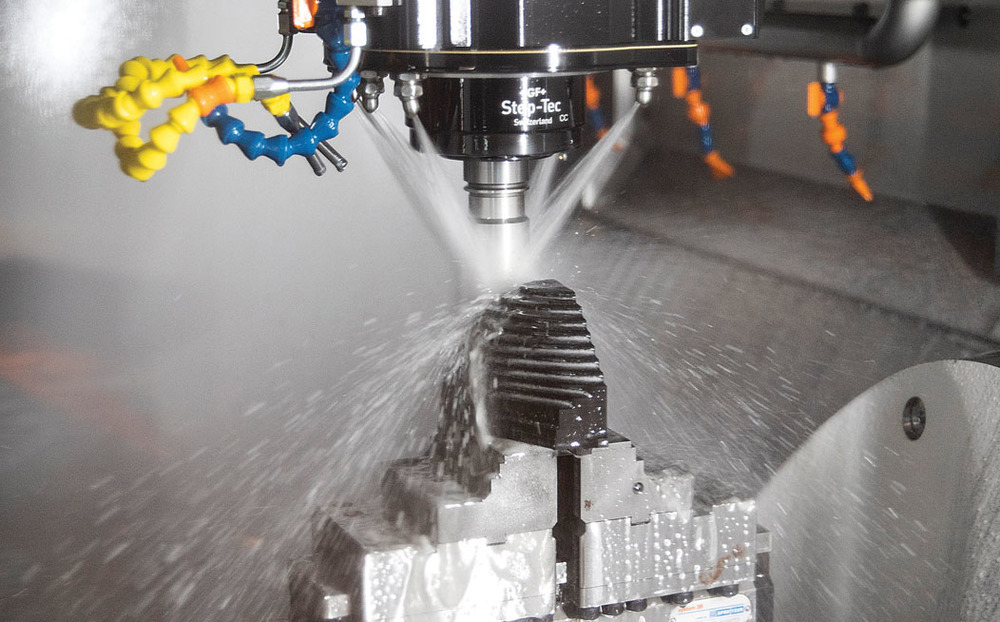
High-pressure coolant is applied when machining this graphite workpiece. Blaser Swisslube
Refining Recipes
Coolant manufacturers are challenged, however, by the need to produce formulations that are not only effective but adhere to ever tightening environmental regulations. While the European Union has regulations restricting boron, formaldehyde-releasing agents and biocides in coolant, Jennifer Johns, applications engineer at Castrol, said U.S. customers are actively trying to eliminate chlorine, or chlorinated paraffins, in neat cutting oils. “Chlorine in the states is much more heavily regulated. They want to reduce chlorine in their waste stream, as well as their reporting.”
Nonetheless, coolant manufacturers often have a global reach and develop formulations that are suitable for multiple markets. Castrol, for instance, developed XBB technology to provide cutting fluids that are formulated without boron, biocides or formaldehyde-releasing agents and use a dual-action chemical buffer that resists changes in pH, according to the company.
In addition, Castrol says customers using XBB technology report extended coolant life. “We have customers that have gone seven even up to 10 years on a big central system without dumping and recharging with the XBB,” said Brian Halstead, technical engineer for Castrol.
With that XBB formulation, Johns emphasized that it is critical to monitor the pH level and make sure that it does not drift. Management of pH for a coolant without boron and biocide can be challenging. “Managing the coolant has to be much more intensive. You can’t skip several days and not look at the level.”
She added that Castrol’s Techniclean XBC water-based cleaners can be used with XBB formulations to extend coolant life and give a boost to the coolant by recycling spent cleaner at the end of its useful life into the coolant. This is done without compromising the coolant performance while reducing water consumption and used cleaning fluid disposal costs.
In Europe, boron is considered a substance of very high concern, Reynolds pointed out, so Blaser Swisslube does not formulate its coolant with boron. Nonetheless, certain secondary amine packages are still being used by various coolant manufacturers, which preform various functions, like corrosion inhibition and pH buffering agents. However, these secondary amines are inherently toxic to microbes, which produces a biocidal side effect. The FDA regulates, approves and registers biocides for use in the metalworking fluid industry. These biocides undergo toxicological safety studies for human compatibility, whereas these secondary amines being utilized do not, thus making them an unregistered biocide. “One additive that we see that’s a secondary anime is DCHA, or dicyclohexylamine — a rather nasty additive.”
A better approach, according to Reynolds, is to look at formulations that contain ingredients that bacteria cannot metabolize and use as food to grow and degrade the coolant. One example is the Blasocut Bio-Concept in which water-miscible Blasocut emulsions stay biologically stable without needing any bactericides, preventing bacteria from becoming resistant to an additive and causing the additive to be no longer effective. “One thing when you try to combat bacteria, fungi and microbes in general with biocides, it’s a losing proposition. It comes back to the old adage from the movie ‘Jurassic Park,’ life finds a way. We have coolants running three to four or five years now that have absolutely no bacteria growth and there are no biocides in those coolants.”
Mix Master
Using the proper coolant formulation for an application is important, but the concentrate must be evenly distributed throughout the metalworking fluid, explained Steven Lowery, executive vice president for oelheld U.S. Inc. in West Dundee, Illinois. “Whether it’s a soluble oil, a semisynthetic or even a synthetic, proper mixing is key.”
Proper mixing begins with adding the concentrate to the water, which can be up to 95% of the coolant, Lowery noted. “We use the term ‘O.I.L.’ — oil in last.”
He added that the concentrate should be added to the water with agitation, using at lease a paddle or paint stirrer. “Unfortunately, too many people put the concentration in the bottom of the bucket/container and then they add the water and hope that pouring the water in will mix it properly.”
Review the print ads from this magazine to continue
This quick advertiser review unlocks the rest of the article and keeps the full-screen reader focused on the ads instead of the page chrome.
Continue reading
January/February 2025
Related


 MFGAxis Discussion
Be part of the shop-floor conversation
Like, save, or comment on this CTE story.
MFGAxis Discussion
Be part of the shop-floor conversation
Like, save, or comment on this CTE story.


MFGAxis Discussion