

Flexible manufacturing systems for growth
Steelville Manufacturing Co.
Job shops generally tackle numerous low-volume part runs and often feel that automated manufacturing systems are not suitable for their operations. Steelville (Mo.) Manufacturing Co. begs to differ.
The family-owned and -operated company handled about 10,500 part numbers last year, predominantly defense-related aerospace components, and used two flexible manufacturing systems to produce a vast majority of them, noted John Bell, vice president – engineering for SMC. “We’ve done as many as 13,800 part numbers in a year,” he said, adding that the shop produces an average of 30 pieces of each part number annually.
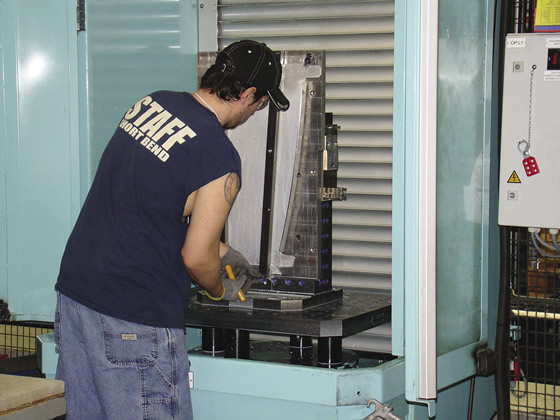
A worker loads parts into a tombstone for machining in the Fastems cell at SMC. All images courtesy A. Richter.
About 15 years ago, SMC installed a Makino A55E 4-axis, 400mm (15.75 “) horizontal machining center as a stand-alone machine and added two Makino A51 HMCs about 8 years ago. The shop then combined the three machines to create an MMC (Makino Machining Complex) automated pallet-delivery work cell. “We can put two more machines on it if we get enough business to fill it up,” Bell said.
Realizing the shop was going down the right automation path while understanding it needed to perform simultaneous 5-axis machining, in 2009 SMC added a Fastems pallet-delivery work cell that marries two Okuma Millac 800HV 5-axis, 800mm vertical machining centers and two Okuma MA600HB 4-axis, 630mm (24.8 “) VMCs. The Fastems/Okuma FMS also includes two tombstone-changing stations and two material-handling stations, one between two machines and the other at the end of the cell.
When installed, the FMS was Fastems’ longest in North America at 167 ‘ (50.9m), according to the company, and still remains one of the longest. When installing the MMC, Bell said SMC planned on adding a second cell at a later date as well, so the company added about 17,000 sq. ft. (5,182 sq. m) to its facility to accommodate both. The addition brought the building to 50,000 sq. ft. (15,240 sq. m).
As with the Makino cell, the second cell has space for up to two more machines. Bell noted adding machines to the Fastems cell is basically a plug-and-play procedure that doesn’t involve adding to payroll. “We can simply add two machines,” he said. “It’s nice to know that I don’t have to bring in more employees [to operate them]. It’s just a matter of capital expenditure.”
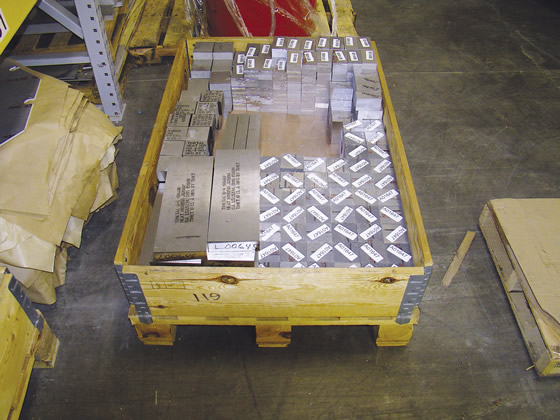
A typical crate for the Fastems FMS is loaded with a variety of workpieces for placing into tombstones.
Although both cells function in a similar manner while processing information a bit differently, the MMC communicates only with Makino machines while the Fastems FMS works with CNC machines from various builders. On the Fastems system at SMC, the shop can add any modern machine tool, according to Michael Bell, director of operations for Fastems LLC, West Chester, Ohio, who’s not related to John. “We have integrated 72 different machine tool manufacturers’ equipment into our systems to date,” he said. “Pallet size is irrelevant as is machine tool type (VMC or HMC).”
Bell added that lathes and mills can even be positioned in a progressive line, if needed. In addition to scheduling jobs, the cells use a track-based, pick-and-place robot to gather workpiece materials and tombstones from multiple-level racks and return them.
Bell emphasized that any mix of parts can justify an FMS, but a shop must have work it can schedule for the system to function properly. This sometimes requires a shift in a company’s mindset. “So many machinists have never really had to do scheduling,” he said. That differs from the typical scenario in which a machinist receives a job from his foreman, completes it, then receives another job.
Hard and Soft Cells
SMC machines a host of workpiece materials, including titanium, Inconel, stainless steel, aluminum, phenolic, plastics and some composite materials. In the Fastems system, Bell said two machines—a 4-axis machine for roughing and a 5-axis one for finishing—are more or less dedicated to cut relatively soft metals and two are dedicated to the more challenging ones.
The arrangement functions fairly well, but Bell conceded it is not ideal, because it limits SMC’s ability to run any part on any machine. “If the whole cell ran one or the other, we could greatly increase our efficiencies,” he said.
Nonetheless, Bell noted the two 5-axis machines in the cell achieve at least 80 percent spindle utilization and frequently hit 90 percent, while the 4-axis machines have a spindle utilization from 40 to 60 percent. Achieving higher spindle utilization is easier to achieve when the need to write part programs, which is done offline, is not as demanding.
“Last year, we did a little over 2,000 first articles,” Bell said. “We will likely do about 1,500 to 1,800 first articles this year, but we still are getting 100 to 150 new parts each month.”
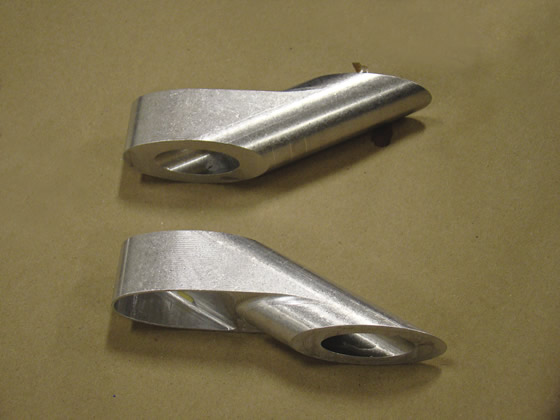
An example of the type of parts SMC produces for the aerospace industry that require 5-axis machining.
The shop runs three shifts 5 days a week, with the day shift being the most manned. It uses that shift to produce first articles and other critical components. During the first shift, two people run each cell, whereas only one person runs each cell during the second shift and one person runs both cells during the midnight shift.
Prior to adding the Fastems system, SMC employed slightly fewer than 50 people, Bell said. Some of those workers were concerned that more automation would jeopardize their jobs. “Their automatic response was that ‘you’re not going to need us,’ but we’ve done nothing but hire more people since putting it in,” he said, adding that SMC employs 138 workers. Those additional hires are not necessarily tending machine tools; the automation created positions in shipping and receiving, inspection, quality and programming.
“The cells have actually decreased our need for skilled machinists,” Bell said. However, he added that the cells make the production process more difficult because SMC needs programmers with significantly higher skill levels to keep everything moving, especially with the volume it has. “We’ve had as many as seven programmers operating at one time, and we could always use two or three more.” The shop didn’t have 5-axis programming capability when it installed the Fastems system.
Tracking Down Talent
Finding the required talent to grow can be a challenge for any manufacturer, and particularly for one located in a town with some 1,600 residents and 90 miles from the nearest city. “Being out here in the middle of the country, we don’t have a deep bench of talent to draw from,” Bell said.
Review the print ads from this magazine to continue
This quick advertiser review unlocks the rest of the article and keeps the full-screen reader focused on the ads instead of the page chrome.
Continue reading
May 2015
Related

 MFGAxis Discussion
Be part of the shop-floor conversation
Like, save, or comment on this CTE story.
MFGAxis Discussion
Be part of the shop-floor conversation
Like, save, or comment on this CTE story.


MFGAxis Discussion