Flexible Hone Plays Role in Raising the Costa Concordia
The Flex-Hone Tool, characterized by the small, abrasive globules that are permanently mounted to flexible filaments, has long been used for everything from automated metal…
Submitted by Brush Research Manufacturing Co. Inc.
The Flex-Hone Tool, characterized by the small, abrasive globules that are permanently mounted to flexible filaments, has long been used for everything from automated metal finishing to maintenance and repair operations. Now the Flex-Hone can add one more claim to its resume: playing a small, but important, role in one of the largest engineering feats in marine history—the raising of the shipwrecked Costa Concordia.
The 952 foot long, 17 deck high cruise ship the Costa Concordia was wrecked off the coast of Isola del Giglio in Italy on Jan. 13, 2012. It was declared a total loss and 32 people lost their lives. The ship eventually settled on its starboard side in shallow waters with half the boat still submerged.
Concerned about a potential environmental disaster that could result from the large quantity of fuel and oil remaining in the ship’s tanks, not to mention a large quantity of rotting food and other health concerns, a salvage effort to move the ship to a suitable port where it could be properly dismantled was commissioned. The effort, awarded to the American salvaging firm Titan Salvage and Italian underwater construction firm Micoperi, ultimately cost an estimated two billion dollars and took several years.
The endeavor to raise the Costa Concordia enough to move it, involved a series of complex steps, several of which had not been attempted in decades.

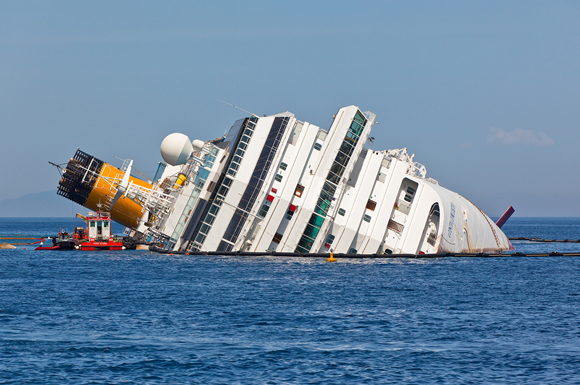
The endeavor to raise the Costa Concordia—a 952-foot-long, 17-deck-high cruise ship wrecked off the coast of Isola del Giglio in Italy—involved a series of complex steps, several of which had not been attempted in decades. Images courtesy Brush Research Manufacturing.
The first step was to secure the hull to the land using steel cables to prevent the ship from slipping into deeper water. A horizontal underwater platform was then built just below the ship’s position to hold the ship once it was raised.
Hollow, watertight tanks, called sponsons, were then attached to the exposed port side of the ship. When sponsons are flooded with seawater, they exert a downward pull on that side of the ship. With the assistance of winches attached to the platform, a process called parbuckling, the ship was pulled into an upright position on top of the underwater platform.
Once the ship was vertical, water-filled sponsons were attached to the starboard side as well. Then, both sponsons were emptied of water to create the required buoyancy to raise the ship enough so it could be towed to port.
The challenge for Micoperi, a leading offshore contractor that provides subsea solutions for the offshore oil and gas industry worldwide, was to find a way to attach 15 massive steel sponsons to each side of the ship. The 30 sponsons weighed 11,500 tons, combined.
The plan was to weld the steel sponsons to the hull of the ship, but also to join them together to form “one single, robust, stable body,” similar to one integral floating chamber. For this, male and female “joints” were attached to each container so they could be connected to each other. A tubular frame would then be run through each of these joints to attach all the containers together. Hydraulic pistons within the tubes would pressurize the system to further hold the tanks together as one unit.
Review the print ads from this magazine to continue
This quick advertiser review unlocks the rest of the article and keeps the full-screen reader focused on the ads instead of the page chrome.