
Economics Of Drilling
Labor is the largest expense in a machine shop, which is why every shop must balance tooling costs and labor efficiency to optimize drilling operations.
Labor is the largest expense in a machine shop. Because of this, every shop is working to reduce the amount of labor that is in machined parts, and reducing cycle times is the fastest way to reduce labor cost in a part. For machinists and engineers, this typically means cutting faster, which usually motivates them to start looking for more advanced cutting tools.
While cutting faster can reduce labor cost, it can also increase tooling expense, which can offset the labor savings. Worse yet, it can increase the cost of the part.
Understanding the true cost of cutting tools is critical to achieving the best overall cost of a part. Drilling is the most common machining operation and therefore the most common place to see an imbalance between tooling cost, cycle reductions and labor costs.
To illustrate this situation, let’s consider a 5/16″ diameter drill making a ½” deep hole in steel. While there are several styles of drills available, the most common choices in this size are going to be high-speed steel (HSS) or solid carbide. Most machinists and engineers are going to select the carbide by default because we all know that carbide will drill a hole faster than HSS. However, that does not guarantee it is the most economical.
We must calculate total cost per hole to understand if carbide is the best choice. For this comparison let’s use the following cutting parameters.
For a carbide drill:
- Cutting speed is 300 sfm.
- Feed rate is 0.005″ per revolution.
For HSS drills:
- Cutting speed is 50 sfm.
- Feed rate is 0.005″ per revolution.
Using these parameters, we see that the carbide drill can penetrate the steel at roughly 18″ per minute, whereas the HSS drill penetrates the steel at 6″ per minute. The carbide drill is three times faster, so it should be the better choice, right? Maybe.
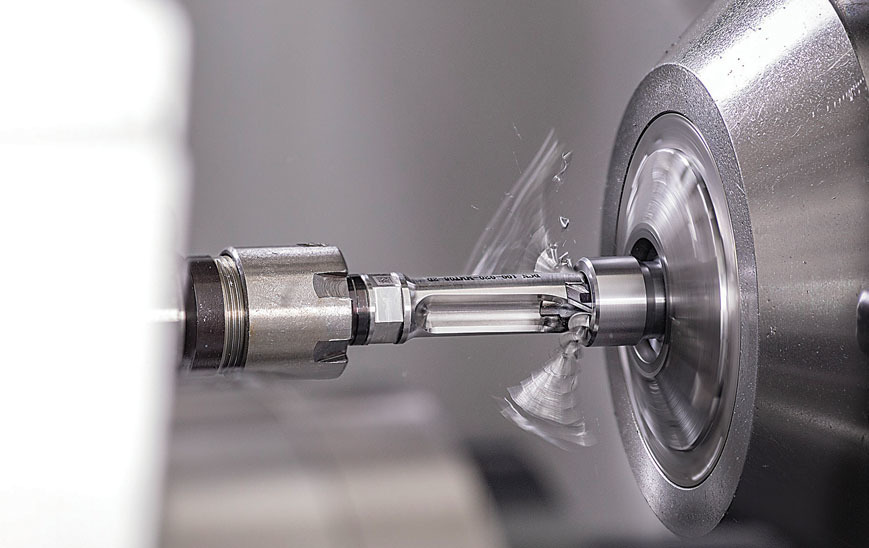
We must also consider the cost of each tool. According to a cutting tool catalog, the carbide drill cost is $50 and the HSS drill cost is $20 (both from a respected manufacturer). Some people might be inclined to use the acquisition cost as a determining factor, which would make the HSS drill a better choice because it is cheaper. But that is not always the case.
Using the cutting parameters and the standard calculation of rpm times feed per revolution, we can determine the time it takes to make the hole with each tool. If we apply the hourly rate to this time, we can see the total labor cost, which is constant. The drill cost is variable and depends on the number of holes that are being drilled. Using an arbitrary, but reasonable, labor rate of $75 per hour, and factoring in the time it takes to drill 50 holes using the parameters above, the HSS cost per hole is $0.50 and the carbide cost per hole is $1.03. In this scenario the HSS drill is more economical.
Review the print ads from this magazine to continue
This quick advertiser review unlocks the rest of the article and keeps the full-screen reader focused on the ads instead of the page chrome.