

Cryogenic machining systems can extend tool life and reduce cycle times
Efficient removal of heat from the tool/workpiece interface is the main route to high-productivity machining. Several conventional methods are available to accomplish that -- dry machining, minimum-quantity lubrication, flood coolant and high-pressure coolant -- but cryogenic machining can be added to the list.
Efficient removal of heat from the tool/workpiece interface is the main route to high-productivity machining. Several conventional methods are available to accomplish that—dry machining, minimum-quantity lubrication, flood coolant and high-pressure coolant—but cryogenic machining can be added to the list.
However, not all systems using cryogens take the same path to longer tool life and higher speeds and feeds. Presented here are three approaches, two of which use liquid nitrogen (LN2), while the other applies liquid CO2 mixed with air or an aerosol dry lubricant.
Watch for Flying Ice
At -321° F (-196° C), nitrogen is an effective, residue-free cryogen for combatting a cutting tool substrate’s worst enemy—heat. “If you don’t efficiently remove the heat, the result is thermal softening of the cutting tool and tool failure,” said Rana Ghosh, applications R&D manager for industrial gases at Air Products and Chemicals Inc. The Allentown, Pa., supplier of industrial gases developed the ICEFLY cryogen-delivery system and associated machining know-how to apply a cryogen at the cutting zone. The technology, which the company licenses, maintains a temperature from -250° F to 32° F (-157° to 0° C).
The system uses a proprietary coaxial, or tube-in-tube, geometry to flow high-pressure LN2 through the inner line and a low-pressure stream of LN2 through the outer line to minimize heat loss in the inner tube, Ghosh noted. The saturated, high-pressure LN2 stream is jetted through an external nozzle and immediately evaporates after impinging on the target surface, without leaving any residue.
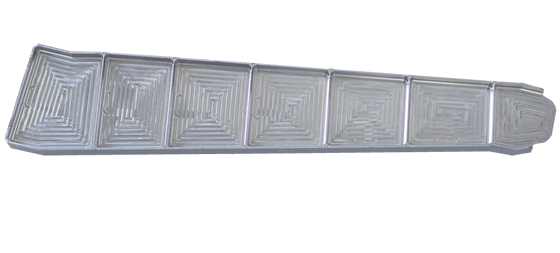
According to 5ME, Lockheed Martin machined a medium-sized titanium (Ti6Al4V) aerospace structural component 52 percent faster with 5ME’s cryogenic machining technology than with coolant.
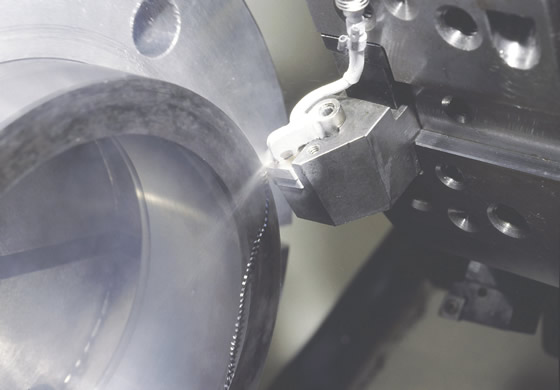
The ICEFLY cryogen-delivery system delivers nitrogen gas to cool the cutting edge.
One such nozzle, which can be retrofitted to virtually any vertical or horizontal machining center, is the Spidercool servodriven, programmable nozzle from Dimensional Control Inc., said Rick Knopf, owner of ICEFLY-licensee Industrial Cryogenic Technologies LLC, Macungie, Pa. The standard Spidercool, however, was redesigned with some new internal components to operate at such low temperatures without binding.
Ghosh noted ICEFLY is primarily targeted at five application areas: steel and iron harder than 45 HRC; sinter-hardened or heat-treated powdered metals; hard metal-matrix composites; cobalt chrome and other difficult materials for medical implants to avoid the use of traditional metalcutting fluids (long suspected as a source of contamination); and implants made of polymers, such as silicone, polyurethane and PEEK (polyether ether ketone).
When machining polymers, temperature control of the workpiece is key to prevent surface defects, such as cracking from overcooling and surface smearing and burr formation from undercooling, Knopf explained. Through optimal cooling of the uncut surface just prior to machining, the cryogen eliminates or greatly minimizes burr generation and enhances machinability. One example is a soft contact lens. “If you increase the modulus or stiffness of the workpiece surface, you can machine it,” he said. “Otherwise, you’re trying to machine a gummy bear.”
Unlike cutting metals, when machining polymers, the nitrogen stream is directed to the polymeric workpiece. To avoid overcooling and potentially introducing cracking when machined, Air Products developed a patented process that uses a mixture of liquid and gaseous nitrogen.
“We can dial in the optimal temperature of the fluid that needs to be jetted onto the material,” Ghosh noted, adding that the glass transition temperature of various polymers is a good starting point to establish cooling conditions with further optimization achieved through testing.
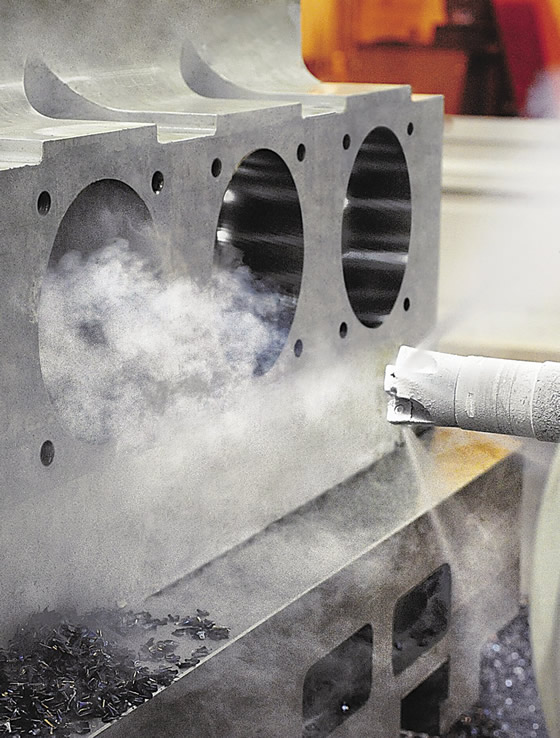
The cryogenic machining system from 5ME uses tube-in-tube, vacuum-jacketed feed lines to deliver LN2 from an external bulk storage tank to the cutting zone while protecting the integral machine components from being exposed to the low temperatures.
Applications expertise is a critical component of the cryomachining equation. For the majority of metalcutting, the focus is on cooling the tool and controlling the temperature and dimension of the workpiece, Ghosh explained. In situations involving workhardening materials or interrupted cutting, however, the focus is only on cooling the tool. For those cases, liquid nitrogen is injected from underneath the cutting tool. This enhances conductive cooling through the tool, while minimizing hardening of the unmachined work surfaces by overcooling.
According to Ghosh, cryogenic cooling can allow an end user to increase productivity 50 to 200 percent through a combination of higher cutting speeds and enabling the use of brittle cutting tool materials, such as alumina ceramics, in many applications where such tools cannot be used with flood coolant or when dry machining. However, greater gains are possible. In one wrought cobalt-chrome application, after switching from flood coolant and carbide tools to cryogenic machining and ceramic tools, the cutting speed went from 100 to 125 sfm (30.5 to 38.1 m/min.) to 550 to 700 sfm (167.6 to 213.4 m/min.).
Cryogenic machining also extends tool life, but manufacturing economics dictates that extended tool life shouldn’t be a primary goal. “Customers want to translate any tool life improvement into productivity gains because just having tool life improvement isn’t economical unless the tool material is PCBN or PCD,” Ghosh said.
Standard cutting tools are used, but Knopf pointed out that a major toolmaker purchased an ICEFLY system to conduct research on developing an insert grade specifically for cryogenic machining.
An Internal Approach
Liquid nitrogen can also be delivered through a machine tool spindle and a cutting tool directly to the cutting edge. This is the method Cincinnati-based 5ME LLC employs with its Cryo technology. The cryogenic machining system uses tube-in-tube, vacuum-jacketed feed lines to deliver LN2 from an external bulk storage tank, or dewar (vacuum flask), to the cutting zone while protecting the integral machine components from being exposed to the low temperatures, said Pete Tecos, executive vice president of marketing and product strategy.
Installation of the Cryo kit doesn’t involve removing the spindle. Instead, a lance, which also has the tube-in-tube, vacuum-jacketed design to keep the OD at ambient temperature, runs through the drawbar ID, noted Michael Judge, executive vice president of business development. “It’s very noninvasive.”
A vacuum-jacketed line, however, doesn’t run through a cutter body, so 5ME designed a line of indexable and solid-carbide cutting tools insulated with PTFE (polytetrafluoroethylene) to use with its cryogenic machining technology. “You cannot run the 5ME cryogenic machining technology system with non-5ME cryogenic tools,” Judge said. The company sells end users about 60 families of cutting tools, including endmills, facemills, high-feed mills, thread mills, drills and turning tools.
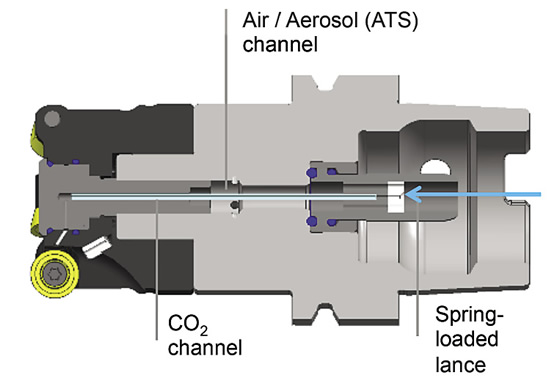
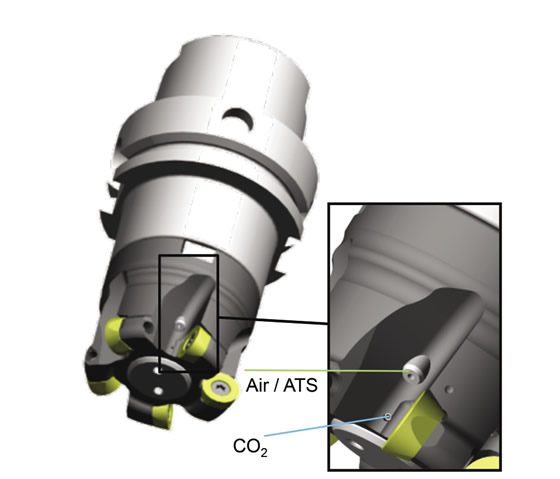
Cryo·tec tools from Walter have two cooling channels: one for CO2 and one for an aerosol dry lubricant or air. The tools have an optimized diameter and CO2 channel directions, as well as a tool shape designed to transport aerosol and air from the spindle through the tool body and to the insert.
Although 5ME is machine tool agnostic and willing to work with any builder, Judge noted the targeted machines are medium-sized horizontal machining centers and large vertical machining centers. This means an HMC with at least a 630mm (24.8 “) pallet size and a VMC with a large spindle, such as CAT 50, CAT 60 or HSK 100A. Targeting these machines helps ensure a reasonable payback because the Cryo hardware kit is about 30 percent of the cost for a new machine tool that size and larger.
Review the print ads from this magazine to continue
This quick advertiser review unlocks the rest of the article and keeps the full-screen reader focused on the ads instead of the page chrome.
Advertisers included in this article experience
Print placements connected to this article
Systems from PRAB
The New Modular
Chip Processing Engineered to Get You Up and Running Faster Fully-integrated chip processing systems from PRAB combine prewired modules that integrate and communicate seamlessly. They move and process scrap and fluid efficiently and maximize returns. They’re also designed for mobility as your process changes. PRAB engineering designs every system to meet your specific application
The New Modular Chip Processing Systems from PRAB Engineered to Get You Up and Running Faster Fully-integrated chip processing systems from PRAB combine prewired modules that integrate and communicate seamlessly. They move and process scrap and fluid efficiently and maximize returns. They’re also designed for mobility as your process changes. PRAB engineering designs every system to meet your specific application.
Visit Systems from PRAB View this placement in the issue recordPrint ads from this magazine
Chip Processing Engineered to Get You Up and Running Faster Fully-integrated chip processing systems from PRAB combine prewired modules that integrate and communicate seamlessly. They move and process scrap and fluid efficiently and maximize returns. They’re also designed for mobility as your process changes. PRAB engineering designs every system to meet your specific application
The New Modular Chip Processing Systems from PRAB Engineered to Get You Up and Running Faster Fully-integrated chip processing systems from PRAB combine prewired modules that integrate and communicate seamlessly. They move and process scrap and fluid efficiently and maximize returns. They’re also designed for mobility as your process changes. PRAB engineering designs every system to meet your specific application.
Continue reading
February 2015
“The return on investment for customers willing to share their data with us is from 8 to 14 months,” Judge said. “Our goal is to keep it within 18 months.”
Because the cryogen is vented away from the workpiece, the system prevents it from making the material more challenging to machine. An exception is when cutting composites, where allowing some liquid nitrogen to overflow avoids workpiece tearing or delamination, Judge said. “We did a 3-month testing plan with one of the larger commercial airline OEMs specific to drilling and trimming composites.”
To quantify the technology’s productivity when cutting metal, Judge noted an application at Lockheed Martin in which a medium-sized titanium (Ti6Al4V) aerospace structural component was machined 52 percent faster with 5ME’s cryogenic machining technology than with coolant (see photo on page 51). In addition to reducing cycle times, the LN2 process improves surface integrity and part quality by reducing residual stress, burr formation, grain boundary distortion and white, or martensitic, layer production during machining, according to company test results.
“All of those are just value-added benefits above and beyond being able to machine parts much faster and with less cost, as well as the green aspects for improved operator health and safety with the elimination of cutting fluids,” he said.
5ME continues to gain momentum with machine tool builders interested in Cryo, according to Judge, who expects development of “a significant number” of new projects in 2015. This perhaps is most clearly demonstrated by a strategic alliance signed between Okuma America Corp. and 5ME, according to Judge. In parallel, 5ME will integrate its cryogenic system onto one of the machines in Okuma’s new Aerospace Tech Center in Charlotte, N.C.
Nonetheless, the highest hurdle to market acceptance may be the end user’s mindset. “We don’t have any direct competition with the intellectual property we have at 5ME,” he said. “It’s more about finding customers who have the right culture, are committed to change and looking for the next leapfrog technology to make parts faster and cleaner.”
Mix and Match
Liquid nitrogen isn’t the only cryogen in town. At -78.5° C (-109.3° F), liquid CO2 seems balmy compared to the frigidity of LN2, but it is effective at holding a cutting tool at ambient temperature to extend tool life and boost productivity while imparting finer finishes compared to noncryogenic approaches, according to Kevin Maples, RCC (regional competence center) Americas – aerospace and energy for Walter USA LLC, Waukesha, Wis.
Vikki Franke, project manager for cryogenic tooling in the R&D department at Walter AG, Tübingen, Germany, explained that CO2 is transported in a liquid phase at room temperature to the tool exit, where it expands into a gas and the low temperature occurs.
The manufacturer of precision tools developed Cryo·tec cutters for cryogenic machining (see diagrams on page 54). It teamed with the Starrag Group to demonstrate the CO2 cooling system in machine tools from the Switzerland-based builder, which offers retrofit services for its equipment. The retrofit includes exchanging the machine spindle.
“Technically, it’s not a problem to provide this technology for every existing Starrag machine on the market today,” said Michael Schedler, marketing manager for Starrag. (Starrag USA Inc. is located in Hebron, Ky.)
However, he noted Starrag is primarily targeting the system at one application: simultaneous 5-axis machining of blisks and blades, such as turbine blades, made of difficult-to-machine materials.
Unlike through-spindle, through-tool LN2 systems, the Starrag/Walter arrangement offers two channels: one for CO2 and one for air or an aerosol-based dry lubricant. This enables an end user to apply CO2-cooled aerosol, CO2 and air, just aerosol, just air or just CO2. When machining titanium, for example, Franke pointed out that some lubrication is needed to reduce friction.
She added that when air alone won’t do the trick, CO2 can be added, balancing the two for machining effectiveness and economy. “You try to use as little CO2 as necessary,” she said.
The tool bodies, which reportedly have an optimized diameter and cryogenic cooling channel, are specials, but accept standard indexable inserts, Franke noted.
While the tools are still being developed, Maples said one application saw a 44 percent productivity gain by switching from dry machining to CO2-cooled air, and the process can extend tool life by 50 to 70 percent.
Another significant indicator of cryogenic machining’s potential is the level of interest. “We’ve had discussions with a lot of customers and a lot of these projects sound very promising,” Schedler said. “I think it will have a big impact.” CTE
Contributors
Air Products and Chemicals Inc.
(866) 826-6035
www.airproducts.com
5ME LLC
(513) 719-1600
www.5me.com
Industrial Cryogenic Technologies LLC
(610) 966-8221
www.industrialcryotech.com
Starrag USA Inc.
(859) 534-5201
www.starrag.com
Walter USA LLC
(800) 945-5554
www.walter-tools.com/us
Glossary terms in this article
Related



Subscribers can use MFGAxis notes, saves and discussion tools with their innoNET account.


