

The contours of a robotic 3D-printing platform
Arevo Labs hopes its new RAMP leads to better 3D-printed componets for the defense and aerospace industries.
Arevo Labs hopes its new RAMP leads to better 3D-printed componets for the defense and aerospace industries.
Arevo touts RAMP (Robot-based Additive Manufacturing Platform) as the first system of its kind optimized for 3D printing of composite thermoplastic parts. The system includes a 6-axis robot arm and end-effector hardware for deposition. RAMP can accommodate build envelopes from 1,000 cu. mm to 8 cu. m, depending on the size of the robot used. The end effector consists of a deposition head with special thermal management technology for processing carbon-fiber-reinforced thermoplastics.

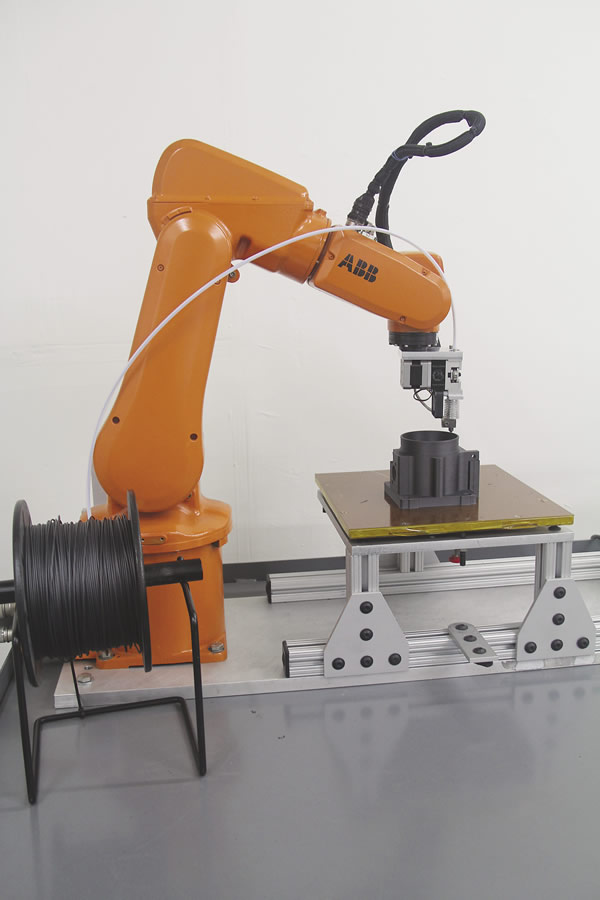
RAMP prints in three dimensions rather than two. Image courtesy Arevo Labs.
RAMP’s CAM software converts CAD models into a set of deposition instructions for the robot. In addition, the software suite includes a kinematics simulator that interprets complex deposition instructions and optimizes part-construction paths.
Review the print ads from this magazine to continue
This quick advertiser review unlocks the rest of the article and keeps the full-screen reader focused on the ads instead of the page chrome.
Continue reading
May 2016
Related


 MFGAxis Discussion
Be part of the shop-floor conversation
Like, save, or comment on this CTE story.
MFGAxis Discussion
Be part of the shop-floor conversation
Like, save, or comment on this CTE story.


MFGAxis Discussion