

Bremen Castings celebrates its 75th anniversary, but doesn’t look back
What do baseball legend Ted Williams slugging his first big-league dinger, Batman comics hitting the streets and Germany attacking Poland to launch World War II have in common?
What do baseball legend Ted Williams slugging his first big-league dinger, Batman comics hitting the streets and Germany attacking Poland to launch World War II have in common? They all occurred in 1939, the same year Ellis Brown, Charles W. Kling and Harold Heckamen founded Bremen (Ind.) Gray Iron Foundry Inc.
The company changed its name to Bremen Castings Inc. (BCI) in 1972 and added a machine shop in 1996. The Brown family continues to run the operation. James L. Brown followed in his father’s footsteps and, although retired, is still on the board of directors. CEO James E. Brown, third generation, took over the leadership role of BCI in 1987. Current President JB Brown is the fourth generation and is now in charge of overall operations at the company. With her graduation from Indiana University this spring, Jordan Brown officially joined the payroll, beginning her career as the fifth generation at BCI as inside sales manager.
Courtesy of All images: A. Richter
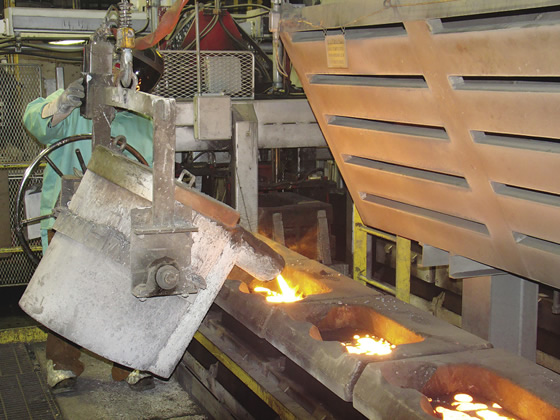
Molten metal flows into a casting at Bremen Castings.
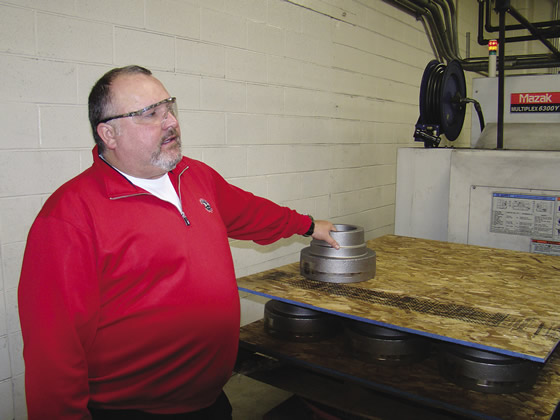
BCI President JB Brown is the fourth generation of the family to run the company.
Although BCI is celebrating its 75th anniversary and is steeped in family history, the company isn’t fond of hanging onto tradition as it continues to automate and otherwise enhance its green sand casting and CNC machining operations. That attitude for positive change is best summed up in BCI’s continuous-improvement motto: StatusQuoSucks!
“It’s how we run everything,” said JB Brown. “If you don’t like change, you will not survive in this company. The world is changing every day and your business has to change to keep up with the times, whether it’s about people, finance, law, whatever. If you’re going to stay status quo, you’re going to be left behind.”
Move to Machining
To help distinguish itself, improve the flow of work through the foundry and create additional revenue, BCI determined that opening its own machine shop was a no-brainer because it provided more value-added services for its customers, according to Brown. “Why should we be out looking for machine shops to machine castings for our customers when we can do it right here and be in charge?”
In addition, the green sand casting process can generate defects. (See sidebar on page 82.) “We used to send them to an outside machine shop; they would machine them and run into issues and all of a sudden we had a lot of back and forth,” Brown said. “So we decided to machine our own castings. We might not be here today if it wasn’t for having a machine shop. This enabled us to offer more value-added services for our current customers and generate new business going forward.”
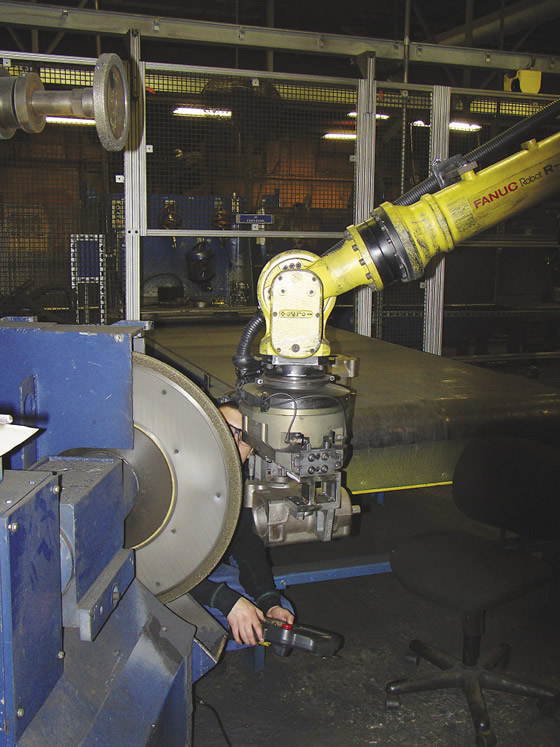
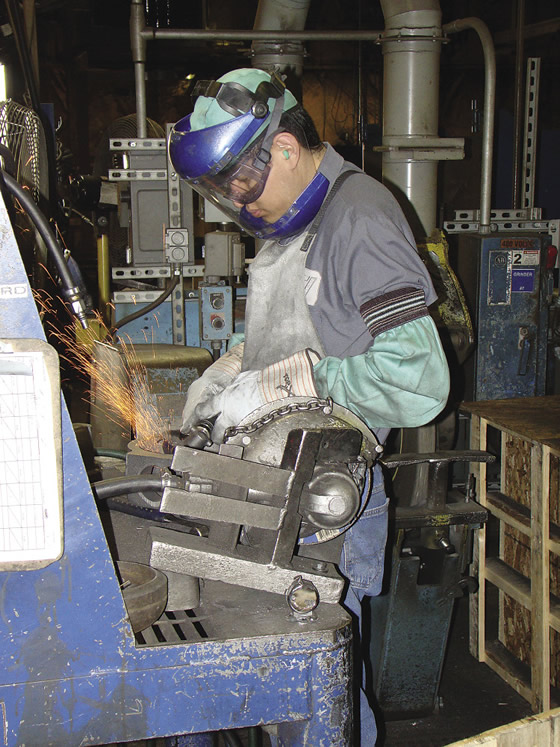
At BCI, castings are manually (below) and robotically ground (above) to remove parting lines, gates, risers and flash.
Nonetheless, he noted that among the approximately 2,100 foundries in the U.S., it’s uncommon for them to have their own machine shops. However, after seeing BCI’s success machining castings, a couple of competing foundries added shops, according to Brown, who pointed out that foundries tend to freely share information to assist others in the industry.
Until 4 years ago, the foundry facility housed BCI’s tightly packed machine shop, which consumed 15,000 sq. ft. The company decided to move it to a 55,000-sq.-ft. warehouse that had sat empty for about 20 years, after gutting the building, adding a new roof and revamping the facility at a cost of $3.5 million.
“Our customers would come to us and say, ‘Hey, would you like to do this project?’ and we always had to turn them down because we just didn’t have room to grow,” Brown said. The company still has room to expand in the machine shop’s building, and owns an additional 13 acres of adjacent land. For now, BCI rents on-site silos to area farmers.
BCI also rents machine tools—to itself. A separate entity, BCI Defense LLC, which Bremen Castings established in late 2012, uses them to produce firearm parts from 7075-T6 aluminum. “Legally, BCI Defense machines parts that have serial numbers. You can’t [make them into weapons] without other components, since that’s what’s considered a firearm,” Brown said about the serial- numbered parts.
In contrast, an upper receiver is a firearm part but not considered a firearm. Therefore, BCI can machine it, Brown explained. This year, BCI started targeting other markets as well, machining parts from steel billet and aluminum castings and is investigating Swiss-style machining.
The core work for the 19-person shop, however, remains machining the foundry’s gray and ductile iron castings, primarily for agricultural, heavy truck, lawn and garden, construction and oil-and-gas applications. Even for the foundry work, BCI functions as a job shop, machining about 1,150 different active casting with volumes from five to 10,000 pieces.
“We have to be able to change on the fly,” Brown said. “We have 40-some different job changes every day.”
Automated Abrasion
Although they are distinct facilities and perform different manufacturing processes, the foundry and machine shop are not run as separate businesses, Brown emphasized. That quickly resolves any machining issues by enabling, for example, the foundry’s head of quality to walk across the street to address a problem. “It’s nice to have that interaction instead of ‘I’ll e-mail you this picture and then catch a flight or drive to your location,’ ” he said.
As a result, returns of parts to the machine shop are virtually nonexistent, according to Brown. “What’s odd is we look at some of the other machine shops we deal with and we still return jobs to them but none to our own,” he said.
BCI, however, doesn’t perform all of its machining in the machine shop. Parting lines, gates, risers and flash on castings are ground in the foundry.
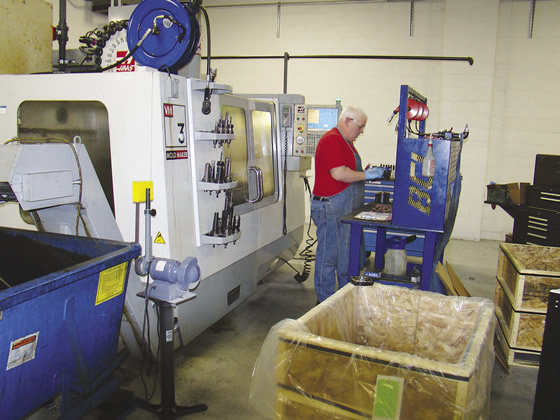
A Haas VM3 CNC vertical mill machines parts at BCI’s machine shop.
Review the print ads from this magazine to continue
This quick advertiser review unlocks the rest of the article and keeps the full-screen reader focused on the ads instead of the page chrome.
Continue reading
July 2014
Related




 MFGAxis Discussion
Be part of the shop-floor conversation
Like, save, or comment on this CTE story.
MFGAxis Discussion
Be part of the shop-floor conversation
Like, save, or comment on this CTE story.


MFGAxis Discussion