Beyond tried-and-true tool holding
Selecting the right toolholder for an application requires understanding some of the available options to enhance accuracy.
Part manufacturers have a host of toolholder types to select from, but the ER collet is the favorite — hands down.
“Clearly, right now it’s the most popular,” said Bill Pulvermacher, director of marketing for YG-1 Tool (USA) Co. in Vernon Hills, Illinois.
End users gravitate to ER collets because they are relatively inexpensive, one collet can clamp a range of tool shank diameters and they are a familiar, time-tested technology.
However, while noting that all ER collets are not created equal, Pulvermacher said they tend to have significant total indicator runout and being able to grab a variety of shanks doesn’t necessarily mean that all shanks are held adequately.
“The flexibility is the reason people buy it,” he said, “but the flexibility is also its downfall.”
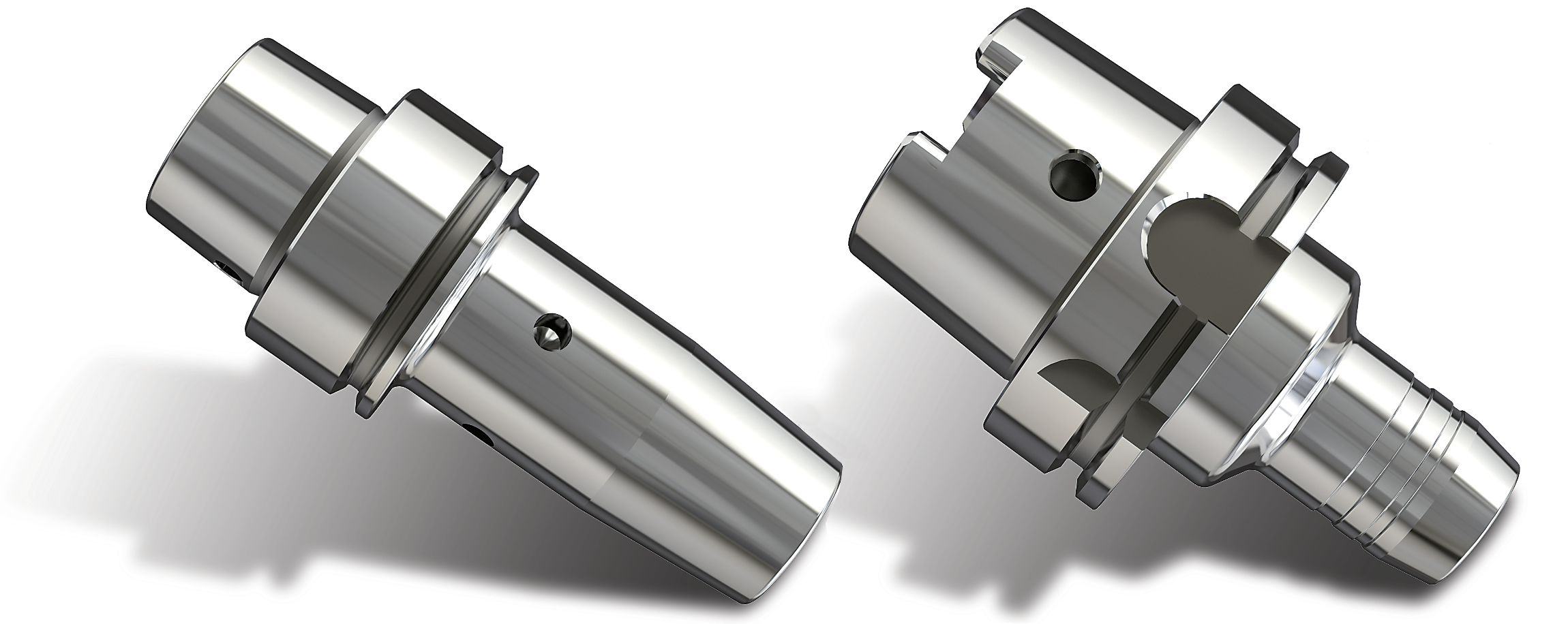
YG-1 Tool (USA) offers a wide variety of toolholders, including hydraulic chuck (right) and shrink fit left). Images courtesy of YG Tool USA
In addition, an ER collet should be tightened to a specific torque value with a torque wrench based on the collet size and diameter of the tool being clamped, Pulvermacher said, but that’s not reality.
“ER collets have a huge overtightening problem too,” he said, “because almost no one tightens an ER with a torque wrench.”
Tom Raun, chief technical officer for Arlington, Texas-based Iscar USA, concurred that the ER collet style is the most popular toolholder, even if it’s not the best one for a particular challenge.
“I do think there are opportunities to provide a more rigid, more accurate toolholder at times,” he said, “but people just tend to fall back on that tried, true ER collet toolholder technology.”
Nonetheless, improvements to the technology are being made. For example, Raun said Iscar introduced a line of collets that eliminates the collapsible range in favor of exact-size collets for popular shank diameters in both inch and metric sizes.
“It gives you more accurate clamping onto the shank of the tool and more clamping force,” he said. “It’s definitely well received, and it was demanded.”
Taper Time
Emuge-Franken USA took a different approach to enhancing that tried-and-true technology, said Milling Products Manager Dan Doiron. In addition to a wide range of high-performance cutting tools, the West Boylston, Massachusetts-based toolmaker sells Franken Precision Chuck holders, which are manufactured by partner company Albrecht.
He explained that unlike an ER collet with its relatively steep angle of about 30 degrees, an FPC holder has a shallow taper of about 1.5 degrees to provide a consistent gripping force along the entire tool shank.
“The taper is what’s aligning a tool into its sweet spot of concentricity,” Doiron said, “and it’s pulling it from the stem versus when you’re going into the ER collet. It’s being compressed from the top with a nut.”
He added: “It looks like a hydraulic holder, but it’s not. It’s mechanical. It has a collet.”
Doiron said having a collet means that an end user isn’t restricted to one tool diameter per holder while the holder’s metal-on-metal compression effectively grips the tool in the collet.
In one application where a customer experienced chatter issues, he said he recommended changing only the holder while running the same cutting tool at the same machining parameters. As a result, the tool produced 350 parts after the switch compared with 65 to 75 parts previously.
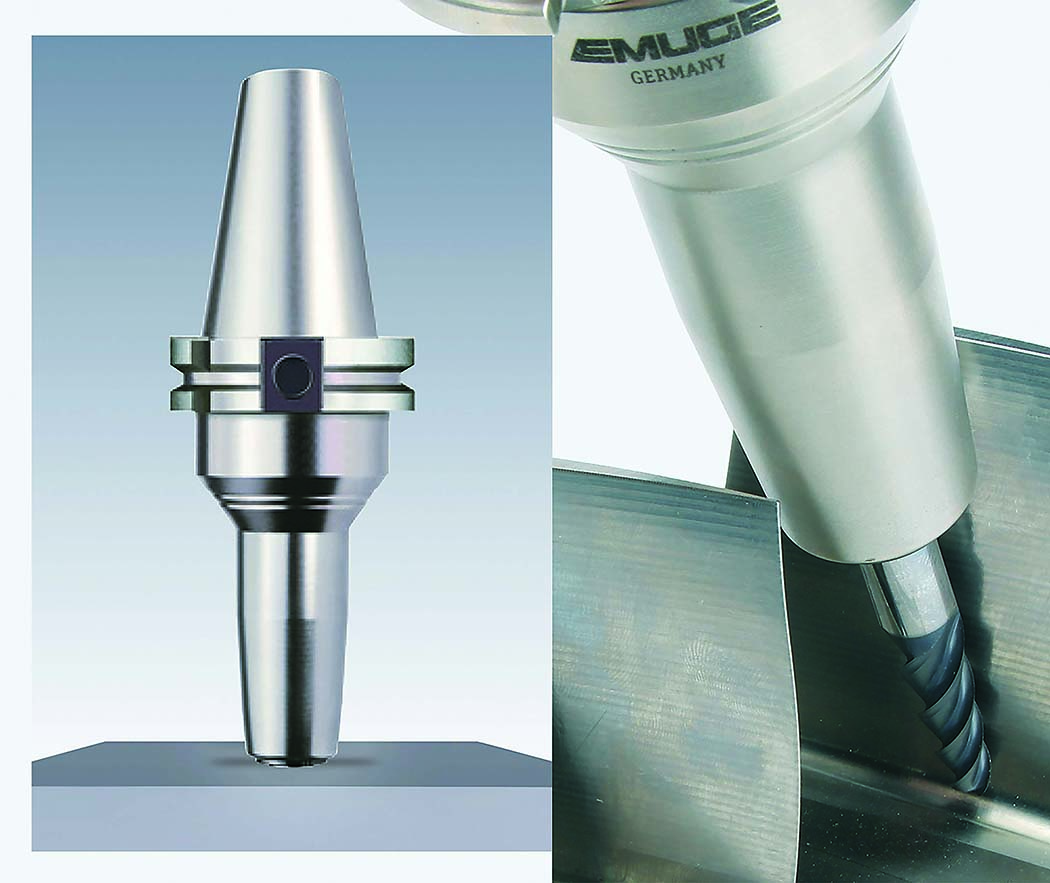
Emuge-Franken offers a slim-line version of the FPC chuck. Image courtesy of Emuge-Franken
Doiron said Emuge-Franken always has offered a variety of toolholders, including ER collet, hydraulic and shrink fit, “but we’ve never had the level of success like we’ve had with our FPC brand.”
One requirement for FPC holders is the use of a torque wrench to achieve a torque value of 10 Newton-meters (7.38 ft.-lbs.).
“When you purchase a holder, it comes with a dual-contact alignment system in which you keep torquing the wrench until two lines align to each other,” Doiron said. “Then you know you’re at the correct torque level.”
He said the company also sells a pneumatic breakaway-style wrench that snaps to indicate when the recommended torque value is reached, as well as a hexagon torque wrench for shops that have relatively large production cells with frequent tool changes.
Review the print ads from this magazine to continue
This quick advertiser review unlocks the rest of the article and keeps the full-screen reader focused on the ads instead of the page chrome.
Continue reading
October 2022
QR codes and videos from this issue
Print QR codes, video callouts, and in-magazine links for this article now point to the CTE video hub in the HTML version.