

Beyond the ROI calculation: Turning Performance
A rational approach to machine tool selection.
A rational approach to machine tool selection.
Since my first manufacturing job in 1976, which was in a screw machine shop, work for me has always been about the machines. Machines remained the focus as I progressed from summer help chamfering bar stock to novice graduate engineer to—many years later—a manager of manufacturing engineering. I’ve selected a lot of machine tools but realized there was no singular, formal defined method to select machinery. I looked around and found no book or selection methods with the possible exception of well-worn accounting principles.
Industrial and manufacturing engineers primarily perform machine selection and cost analysis by what is called “the engineering economy method.” These methods are strictly for capital investment analysis and comparison. They examine the return on investment (ROI) or rate of return based on enhancements to production capacity and capability. That is all well and good, but when I selected machinery, that was not where I started.
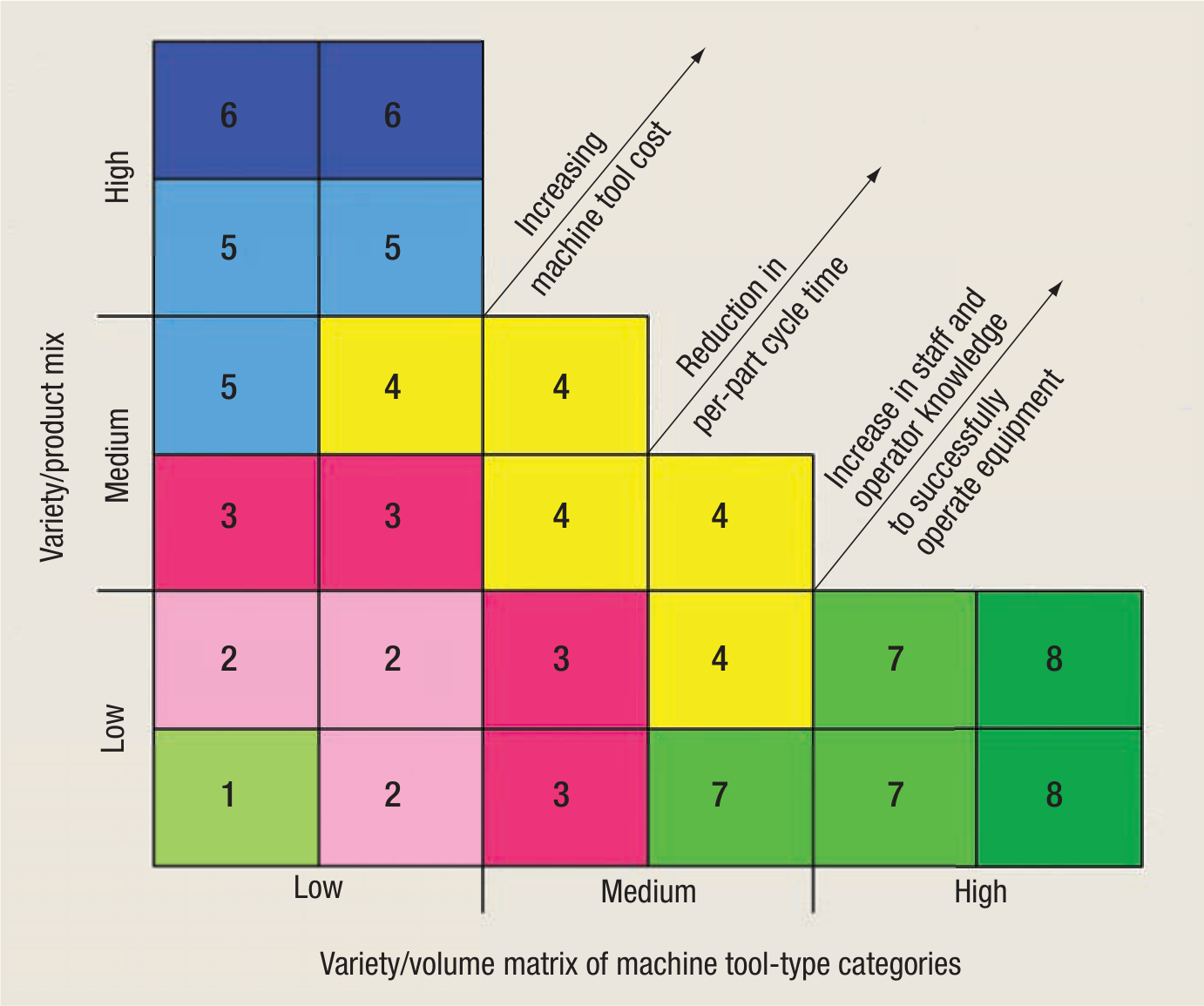
My method was an outgrowth of the methods I saw other engineers use. Those include spreadsheets, marketing data, discussions with plant management and similar “fishing trips” to determine real needs. There was no singular plan taught or used extensively to help the selector—typically the owner, engineer or manager—understand and quantify the considerations and alternatives. It was up to each designated selector to create a method to best pick the equipment. I’ve summarized my method in the graphic on the next page, the variety/volume matrix of machine tool categories.
Machine typeDescription and considerationsCosts (machine/per part)Operator knowledge1
Manual machines with DROs (toolroom equipment), a full range of basic, single-process machines are required. Accuracy is very dependent on operator skill.
Least/highest
Very good to excellent (toolmaker level)
2
Commodity/stand-alone CNC machines, a “no frills machine” with few manufacturer options to increase cost (e.g., through-spindle cooling).
Medium/medium
Basic operator, support by standard engineering
3
Stand-alone, “best in class” CNC machines with selected productivity features that increase part throughput and accuracy. An enhanced version of a commodity machine.
Medium to high/medium
Experienced with full operational support staff
4
Cellular/flexible manufacturing system arrangement. Built from machines that are capable of the concept and can have robotic handling of parts, if required.
Medium to high/medium to low
Experienced with full operational support staff
5
Hybrid machine tools, the new generation of multitasking machines and concept machines that do operations such as hard turning, with top-end tools from top-end makers.
High/medium to low
“Best and brightest” team is required
6
Custom version of No. 5, feature-rich, special design from builder with special workholding and special tools. This is a well-engineered machine with many part-specific innovations.
High/low to lowest
Same as No. 5
7
Transfer machine/multispindle bar machine. A “part family-specific” design and build, using standard modules available from the builder and a range of construction options.
High to highest/low to lowest
Same as No. 5, not for the”uninitiated”*
8
Custom version of No. 7, the highest end of the machine tool builder’s art with special features that can be proprietary to any number of suppliers. The best possible machine but at the highest initial cost.
Highest/lowest
Same as No. 5, not for the”uninitiated”*
* “Uninitiated” refers to the use of equipment by those without extensive previous experience using and supporting the equipment. The use of equipment in levels 7 and 8 will require a huge transition from level 6 equipment. The application will require a much greater level of support in terms of engineering, quality, maintenance, operation and supervision.
Machine tool selection must take into account diverse issues related to machine tool type, operator skill and total capital available. Furthermore, there are no “good” or “bad” machine tools—just ones that are better fits with specific sets of requirements. Awareness of machines and options enhance the ability to pick the “best” machine tool for a specific set of operational conditions, considerations and, of course, budgets. I’ve seen experienced hands achieve more with older, less-sophisticated equipment than those operating new CNC machines.
Machine tool selection is not just an exercise in finding the equipment with the right work cube size and voltage. It is a multifaceted process requiring skill and thought.
Companies have historically improved on manufacturing processes within their facilities. This is not news. In his book, “Fundamentals of Modern Manufacturing: Materials, Processes and Systems” (Prentice-Hall Inc., 1996), Mikell P. Groover stated, “The history of manufacturing can be separated into two subjects: (1) the discovery and invention of materials and processes to make things, and (2) the development of systems of manufacturing.” Machine tool selection addresses both areas.
View one print ad to continue
A two-second advertiser review unlocks the rest of the article. You can explore all the advertisers below or in the magazine.
Advertisers included in this article experience
Print placements connected to this article
©2010 Makino WHERE NEW THINKING TAKES SHAPE.
OUR APPLICATION ENGINEERS LOVE THE SCARY PARTS.
Makino Engineering Services has an unmatched history of creating robust production-ready processes—including machinery, fixtures, tools, programs and documentation—for parts with complex geometries, demanding deadlines, challenging budget constraints and Six Sigma standards. We’ve solved production challenges and engineered tightly integrated manufacturing.
OUR APPLICATION ENGINEERS LOVE THE SCARY PARTS. Makino Engineering Services has an unmatched history of creating robust production-ready processes—including machinery, fixtures, tools, programs and documentation—for parts with complex geometries, demanding deadlines, challenging budget constraints and Six Sigma standards. We’ve solved production challenges and engineered tightly integrated manufacturing systems for hundreds of manufacturers. All with a guaranteed cycle time, lower cost per part and improved quality. Don’t be afraid of the part. Visit us at www.makino.com/engineering or call 1-800-552-3288. ©2010 Makino WHERE NEW THINKING TAKES SHAPE. IS #40
Visit ©2010 Makino WHERE NEW THINKING TAKES SHAPE. View this placement in the issue recordPrint ads from this magazine
Makino Engineering Services has an unmatched history of creating robust production-ready processes—including machinery, fixtures, tools, programs and documentation—for parts with complex geometries, demanding deadlines, challenging budget constraints and Six Sigma standards. We’ve solved production challenges and engineered tightly integrated manufacturing.
OUR APPLICATION ENGINEERS LOVE THE SCARY PARTS. Makino Engineering Services has an unmatched history of creating robust production-ready processes—including machinery, fixtures, tools, programs and documentation—for parts with complex geometries, demanding deadlines, challenging budget constraints and Six Sigma standards. We’ve solved production challenges and engineered tightly integrated manufacturing systems for hundreds of manufacturers. All with a guaranteed cycle time, lower cost per part and improved quality. Don’t be afraid of the part. Visit us at www.makino.com/engineering or call 1-800-552-3288. ©2010 Makino WHERE NEW THINKING TAKES SHAPE. IS #40
Continue reading
March 2010
Be aware, however, that the more factors you analyze, the more complex and time consuming the selection process becomes. The tendency to overanalyze can delay timely selection.
Machine Selection Matters
The globalization of manufacturing has pressured all machine shops to continuously improve or close. As a result, machines, production systems and skill sets must be part of continuous improvement plans.
In revisiting the shop I first worked at 20 years later, I was struck by the changes in machine tools. The Brown & Sharpe screw machines, a staple of the automatic machining market, had all been replaced by CNC machine tools from Japan, Switzerland and Germany. When I asked what happened, the response was that the screw machines could not provide the speed, accuracy and additional features that the newer machines could. The machinists—some of whom I worked with—were excellent and, in some cases, third-generation machinists. They got all they could out of the old “Brownies,” but in today’s parts market it was not good enough to have somewhat-capable machines.
Your existing machine tools and new ones you select define your manufacturing operation. The selection of proper machine tools is key because it “sets in stone” the productive capability of a facility, cell or production line. With the development of lean manufacturing, the selection of machines to achieve lean goals is more critical than ever.
Manufacturing processes are at the heart of machine tool selection. You must understand the manufacturing process you seek to apply before you can effectively select a machine tool to deliver the process. You must investigate the new process to determine its parameters and be assured you are applying the concept correctly. For example, hard turning is done on a lathe but not all lathes are capable of doing this operation. Until you understand the “why” of the key machine tool construction parameters that make hard turning possible, you will not be ready to choose a machine tool for this purpose.
In the past, the changes and upgrades made to basic machine tools were not dramatic. They became bigger, more powerful and better controlled, but were fundamentally the same. Since the mid-1980s, however, machine tools selection has become more complex.
New factors include:
• Increasing use of automated tool and part gaging and live tooling,
• Development of multitask machine tools, a quantum leap in CNC technology,
• Growth of wire EDM and abrasive waterjet cutting, and
• Inclusion of laser cutting on several machine tool types.
Additionally, cellular and lean manufacturing strategies have changed the factory-floor layout. Even the previous “unCNCable” multiple-spindle bar machine, one of the most complex types of machine tools ever made, has embraced CNC technology. Quality initiatives have also shaped the selection process with the use of tool probes, part gaging, coordinate measuring machines and real-time statistical process control (SPC) data now in the mix to reduce dimensional variability.
Supporting robots and the integration of shop floor communication networks to transmit real-time information are also changing machining. In the past, automated loading systems were the realm of transfer machines and other high-volume/low-product-mix machine tools. Today, robotic load/unload systems are standard on some high-end machines and optional on many commodity machine tools.
Impact of Machine Selection
Why is machine tool and process selection more critical to your shop’s success? Because it impacts the following:
• Product cost, including machine operation, labor, tooling, maintenance, process expendables and material cost.
• Quality cost, including product returns, liability, loss of future sales and the time to deal with the poor-quality issues.
• Production cycle time, including the raw cycle time of the manufacturing process steps plus the wait time between operations and the time to inspect the product. This is probably the No. 1 selection criteria on many lists.
• Flexibility/agility of production, including expanded capability to do a wider range of parts.
• Accuracy/reliability of a specific process. If manufacturing engineers don’t know the implications of using different processes based on the product life, tooling life, variability of SPC data and other production considerations, then they need additional education and training. The residual effect of the process can be huge! The best and most common example is the use of a rolled or formed thread to enhance fatigue life vs. one cut on the lathe with a single-point tool or geometric die-head chasing.
• Scrap rate related to production variability. Many different types of machine tools can be used to achieve the same dimensional feature but each will have its own SPC curve for the distribution of the measured dimension. Those capable of tighter Cpk levels will reap the benefits of less scrap.
• Employee skill sets, because the new equipment may be unfamiliar to your staff and require training. Adding unfamiliar equipment can require hiring new operators.
• Speed to market, or the speed of moving from the concept to prototype stage to actual production. This development-to-product value chain is a measure of a facility’s production agility and must be analyzed.
• Machine tool acceptance by employees. This is more of a holdover consideration from the days when U.S.-built equipment was the norm. Buying machine tools can be politically sensitive, especially if there is an acceptable, well-liked U.S. brand available. For established companies, the issues are not with Japanese equipment because they’re now the norm; it’s possibly with Chinese-built machine tools.
• Incorporation of secondary operations into the primary machine tool. Today, the line is blurred between basic machine tool types. New lathes can have milling, grinding or other functions. This capability may eliminate secondary operations or allow the use of better production methods. Also, manual operations such as deburring can be automated and performed more consistently.
• Material utilization. If you’re getting a big check each month from your scrap metal dealer, determine how to reduce your raw material input. For example, switching to a small carbide rotary cutoff saw from traditional parting tools can reduce kerf width, thereby reducing scrap and producing more parts per bar.
Big-Picture Selection Strategy
The machine tool selection process starts with the big picture—the amount of part variety and the volume (production rate) that you need to produce. As a first step, examine the parts, part families and processes that will run on this machine. If you are selecting a machine to consolidate other machine tools, look at the history of parts made, not just the recent ones.
Machine tool selection categories can be divided into eight classes (see diagram on page 69). This diagram is adapted from the traditional part mix/volume matrix. The diagram is not by process, such as turning or milling, but by the available processes, operational features and machine complexity. Additionally, the machine tool categories that are further away from the graph’s origin typically cost more to buy and operate and require the use of more complex machine tool systems to fulfill production. Use this diagram to begin to determine where you should be in terms of the machine tool category and whether your company is a good fit within this category.
When you need high-variety production, high-volume production and a series of secondary operations, no single machine tool can meet that need. Choosing the right mix of machine tools can make your shop more efficient and productive than your competition. CTE
About the Author: John C. Keefe is a principal engineer with Alion Science and Technology Corp., McLean, Va. He can be reached via e-mail at jckeefe@alionscience.com. For more information about the company’s manufacturing technology solutions, call (877) 771-6252, visit www.alionscience.com or enter #330 on the IS form.
Acquiring a new machine is not always the right answer
If you let them, manufacturing engineers can buy a machine tool before their first coffee break and possibly receive delivery the next working day. An additional machine is a simple way to gain capacity and capability, but alternatives exist. But before buying an additional machine tool, first make sure you really need it. The following are some considerations that can avert or slow the need for a new or used machine tool.
• Perform a design for manufacturing and assembly (DFMA) review of a high cycle time, a complex process or poor-quality parts. If it is your product, change design features that reduce manufacturing costs and speed manufacturing. Products and their components must be producible. Designers and manufacturing engineers should do a joint review. If these two engineering groups are not working together on cost reductions and design improvements, now’s the time.
• Reevaluate speeds, feeds and DOCs. Cutting tool representatives can evaluate your processes and recommend tools that push the limits of your machines. In addition, high-pressure coolant can be a cycle-time shaver and tool-life extender.
• Incorporate custom workholding and processing tools to dramatically shorten cycle time. Cost considerations for small quantities may not justify some of these tools. However, as production volume increases, special tools can be economical, including drill/ream and other combination tools that generate multiple geometric features, indexing chucks to complete multiple-sided parts in one fixturing and special burnishing tools instead of cutting tools for long-cycle finish feeding.
• Outsource some production. There might be jobs your shop is not well equipped for or that fall outside your core strengths that can be more done effectively and at a lower cost by others. Target areas that have had production, productivity or quality problems.
• Extend the work day. This is typically the first applied and the simplest way to add capacity without adding fixed costs. Typically, this is a short- to medium-term solution. For the longer term, a permanent additional shift can be added, but it requires additional supervision and related personnel.
• Use a cellular machine tool layout. The advantages include reduction in nonproductive and indirect-labor time and providing the operator a better sense of part-quality ownership. This gives additional time back to the shop for part machining through direct-labor hour availability and focuses the quality effort.
If you have done all of these traditional efforts and still need additional capacity and capability, the next step is to consider an additional machine tool.
—J. Keefe
Glossary terms in this article
Related




Subscribers can use MFGAxis notes, saves and discussion tools with their innoNET account.


