

Band aid
Tips and techniques for improving bandsaw blade life and performance.
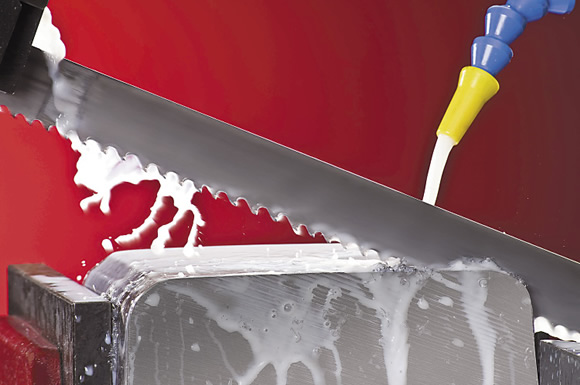
Courtesy of L.S. Starrett
L.S. Starrett’s Advanz TS carbide-tipped bandsaw blades resist wear even when cutting difficult-to-machine materials, such as Inconel, austenitic stainless steel and heat-treated steel.
Tips and techniques for improving bandsaw blade life and performance.
Similar to other cutting tools, bandsaw blades eventually wear—sometimes prematurely. While the easiest way to deal with early blade wear is to just replace the blade, it’s better to examine the possible causes, such as:
■ Incorrect speeds and feeds;
■ Improper or nonexistent break-in process;
■ Too few or too many teeth in the cut;
■ A worn chip brush;
■ Incorrect coolant flow or mixture;
■ Worn blade guides; and
■ Incorrect blade tension on the band.
“In a lot of facilities, sawing tends to be looked on as a simpler operation and is overlooked in the manufacturing process,” said Dave McCallen, North America sales manager–metal products for Simonds International, Fitchburg, Mass. “By paying more attention to the sawing operation—getting a better finish or a squarer cut—customers could possibly eliminate secondary operations. And [better sawing] could also help reduce material waste.”
Concern over tool life varies by user. For example, a big production saw house that runs 24/7 has different needs than a small job shop that uses its bandsaw machine intermittently.
“A 12 ‘- long, 1 “-wide bimetal bandsaw blade costs about $40,” said Gene Ramsdell, manager of North America saw R&D for The L.S. Starrett Co., Athol, Mass. “But a 25 ‘-long, 2 “-wide blade for a big production bandsaw machine could be $150 to $200. A 25/8 “-wide carbide-tipped blade can be $400 to $500. You can live with short life on a $40 blade, but not on a $200 one.”
Bimetal blades are, by far, the most common type of bandsaw blade used and are the most versatile for cutting various materials. These blades feature a thin strip of HSS welded to a wide strip of spring-steel backing material. The HSS offers effective cutting and the flexible backing resists fatigue, prolonging blade life.
Carbide-tipped bandsaw blades resist wear even when cutting difficult-to-machine materials. These blades also have a steel backing. Carbide-tipped blades do not need to be changed as frequently as bimetal blades, but cost more.
“Carbide-tipped blades are for users who want to cut faster and obtain a better surface finish, and they are very good on metals such as tool steel, stainless steel, titanium and nickel-base alloys,” said Matthew Lacroix, director of marketing for Lenox, East Longmeadow, Mass. However, these blades require a more rigid bandsaw machine to minimize vibration because carbide teeth are less forgiving than bimetal ones, he noted.
“Carbide-tipped blades don’t like a lot of vibration,” Lacroix said. “Although the teeth are harder, they can be fragile and so they don’t like high impacts. Carbide isn’t a great choice for thin-walled tube or pipes because of the excess vibration caused by the interrupted cut. That is one reason why bimetal blades are recommended more often for structural applications.”
Bandsaw blades made of carbon steel typically are used in nonferrous applications. “Carbon steel makes up a very small part of the metal sawing market,” Lacroix said. “The bulk of the market is bimetal with 75 percent, and carbide-tipped is about 20 percent.”
Watch the Speeds and Feeds
A good place to start preventing premature wear is by monitoring sawing parameters. Saw blade manufacturers provide guidelines for speeds and feed rates for an application to avoid problems.
“If your speed is too fast and your down-feed is insufficient, the bandsaw blade will rub the workpiece rather than dig into it,” Ramsdell said, adding that rubbing generates frictional heat and dulls the blade.
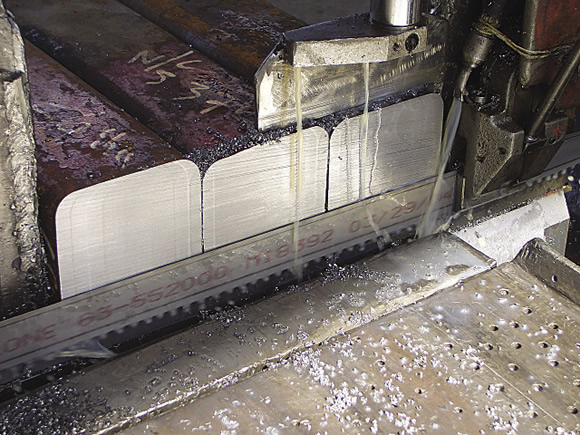
Courtesy of Simonds International
Simonds’ SiClone bimetal bandsaw blade is made for cutting materials prone to workhardening, such as stainless steel.
Running too slowly while cutting certain cross-sections (structurals) such as I- beams or H-beams can cause the teeth to contact a wall or surface too heavily and cause the teeth to chip, Ramsdell noted.
A too-low feed rate is a common error when cutting materials prone to workhardening, such as nickel-base alloys and austenitic stainless and tool steels. “You have to make sure you are constantly taking a chip and cutting under the area that could workharden,” Ramsdell said. Otherwise, the blade will workharden the material and wear prematurely.
Chip formation assists the user in determining if the speed and feed rate are appropriate. “A knowledgeable operator will know what to expect from the material they are cutting,” said Alan Peterson, global product manager for The M. K. Morse Co., Canton, Ohio. “Any deviation from the normal chip appearance will guide them in determining what type of adjustment they need to make. Small adjustments to the speed and feed can position the blade so it is cutting most effectively.”
Chips should be nicely curled “6s” and “9s” and silvery in color. This indicates correct feed pressure, cutting speed and tooth pitch selection. Chip formation is based on the workpiece material.
Chips that are thin like whiskers or powdery indicate the speed is too high and the feed rate is too low. The blade is taking little cuts rather than forming a full chip. (Powdery chips are acceptable when cutting certain cast irons and D-2 tool steel.)
Chips that are too thick and tightly coiled and discolored indicate excessive feed pressure and a too-low speed. “Blue chips mean heat and heat is not good,” Ramsdell said. “Overheating can cause the teeth and band to wear more quickly.”
Don’t Skip the Break-in
The blade break-in process is often compared to taking the sharp point off a pencil. Leaving the sharp point and pushing too hard will cause the point to break. “Starting the blade with less force allows the very sharp points to become honed and withstand the normal speeds and feed rates,” Peterson said.
According to Simonds’ McCallen, a proper blade break-in procedure requires reducing the feed rate by about half of what is normal for production mode, removing anywhere from 25 to 100 sq. in. of material, then gradually increasing the feed so to hone the edges of the teeth, he explained.
Generally, an incorrect break-in that doesn’t apply a high enough feed can cause problems when cutting workhardening materials, according to McCallen. “The blade will rub,” he said. “You still want to be sure you are creating some type of chip.”
Some saw blade manufacturers offer or are working on blades with honed tips to minimize the need for break-in and decrease the possibility of damaging the blade.
This will be a great help because some operators skip the break-in procedure. “Most users are aware of the need for break- in but not everyone does it for a number of reasons,” Lenox’s Lacroix said. “People that really measure blade performance can increase their productivity and cost savings by breaking in the blades to extend their life.”
Brush Your Teeth
Having the wrong number of teeth in the cut negatively impacts wear. The basic rule is to keep at least three and no more than 24 in the workpiece, with six to 12 teeth being optimal. Fewer than three teeth risks tooth strippage and more than 24 teeth risks strippage and gullet clogging.
“If you have too many teeth in the cut, it is hard for the teeth to penetrate because the down force is spread over so many tooth points and the teeth are going to rub,” Ramsdell said. “Also, your gullet capacity is minimized. The gullets will tend to fill up with chips and the teeth can’t penetrate anymore.”
Chip brushes remove chips from the gullets after they have gone through the cut. If the teeth reenter the cut with chips in the gullets, tooth strippage and chip welding are more likely to occur. The chip brush also prevents the blade from carrying chips into the machine, where they can cause damage.
Although the brush is a function of the bandsaw machine, the operator must make adjustments to the brush as it wears to ensure it stays in contact with the blade gullet area and removes the chips. “Sometimes we find customers with brushes so worn out they are not even making contact with the gullets,” McCallen said. “And it is such as an easy thing to change.”
Review the print ads from this magazine to continue
This quick advertiser review unlocks the rest of the article and keeps the full-screen reader focused on the ads instead of the page chrome.
Continue reading
January 2013
Related


 MFGAxis Discussion
Be part of the shop-floor conversation
Like, save, or comment on this CTE story.
MFGAxis Discussion
Be part of the shop-floor conversation
Like, save, or comment on this CTE story.


MFGAxis Discussion